JSCA to train more than 800 officials of the Mexico City Judicial Branch

More than 800 officials from the Mexico City Judicial Branch (PJCDMX) will receive specialized JSCA training on civil and family justice reforms in the Americas, with an emphasis on the installation and strengthening of orality in both areas.

The courses are part of a program supported by the Judicial Studies Institute of the PJCDMX, the Commission for the Implementation of Civil, Commercial and Extinction of Ownership Orality and the Working Group for the Implementation of Mexico’s new National Code of Civil and Family Procedures.

Several Latin American countries, including Mexico, are going through a gradual process of change in their civil and family justice systems to leave behind the logic of the written record and move towards a system of oral hearings where judges can directly appreciate the evidence with their own senses.
The judicial systems of the Americas need to resolve civil and family disputes with transparency and speed in order to guarantee effective access to justice. In this context, JSCA has recognized experience in the development of studies, tools and training to promote justice reforms, both from a legal perspective and from a public policy and management perspective, with a critical and proactive vision of the challenges involved in these processes in the region.

The training developed by JSCA in the Civil Justice Reform and Family Justice Reform courses will be given in partnership with the PJCDMX and will contribute to professionalizing and guiding the discussions and answers to the central questions surrounding the processes of oral reform of civil and family justice, in order to generate quality information and decisions, and to have the necessary tools to adequately implement the changes that will be experienced with the entry into force of Mexico’s National Code of Civil and Family Proceedings.

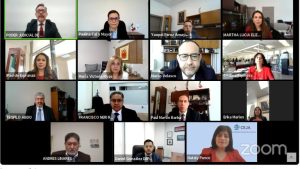
The inauguration of these training sessions was attended by various high-ranking authorities of the Mexico City Judicial Branch, including Presiding Judge Rafael Guerra Álvarez, Ms. Paulina Cal y Mayor Turnbull, General Director of the Judicial Studies Institute of the PJCDMX, and Magistrate Esperanza Hernández Valero, in addition to María Victoria Rivas, President of the JSCA Board of Directors, and Nataly Ponce, Executive Director of JSCA.

Noticias relacionadas:

On April 21, the final session of the course “Investigating Corruption by Following the Money” was held at the Office of the Director of Public Prosecutions in Trinidad and Tobago, marking the conclusion of this specialized training in the country. 
Regional cooperation on justice and citizen participation continues to advance through a new meeting led by the Organization of American States, which brought together in Chile the Center for the Study of Justice of the Americas with civil society organizations, academia, and justice system stakeholders.
On April 17, the Justice Studies Center of the Americas (JSCA) held the closing session of the course “Improving Criminal Prosecution in Cases of Gender-Based Violence in Trinidad and Tobago”, marking the completion of this specialized training programme. 
As part of the specialized training program “Improving Criminal Prosecution in Gender-Based Violence Cases in Latin America and the Caribbean,” JSCA held the second in-person session of the course in Trinidad and Tobago, creating a key space to strengthen the capacities of justice sector professionals in the country. 
The Justice Studies Center of the Americas (JSCA) will begin the first in-person session of the course “Specialized Training Program: Investigating Corruption by Following the Money,” a training initiative aimed at strengthening investigative capacities in corruption cases in Trinidad and Tobago. 
The Justice Studies Center of the Americas (JSCA/CEJA ) began on March 16th the implementation in Trinidad and Tobago of the international course “Investigating Corruption by Following the Money,” a training program aimed at strengthening investigative and prosecutorial capacities to address corruption cases in Latin America and the Caribbean.