The Justice Studies Center of the Americas (CEJA) is proud to present the English version of the first comparative Index of Judicial Congestion in the Americas: I Index of Judicial Congestion in the Americas: Comparative Study of Judiciaries 2025.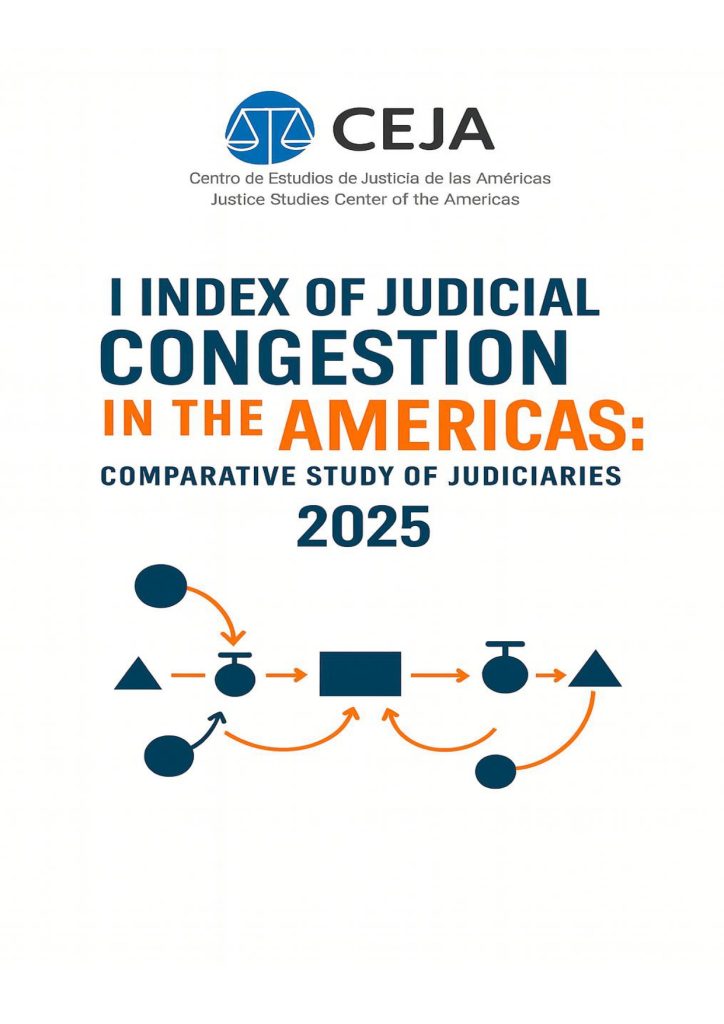
This pioneering study analyzes the performance of judicial systems in 13 Latin American countries over the past six years, providing key data on case resolution and backlog levels. The Index offers a clear picture of how congestion affects access to justice, highlighting critical challenges and opportunities for reform.
By publishing this Index in English, CEJA aims to expand its reach and relevance for countries in the Caribbean and beyond, fostering regional dialogue based on comparable evidence.
Which countries are analyzed by CEJA’s new Judicial Congestion Index?
The Index examines judicial data from Brazil, Bolivia, Chile, Colombia, Costa Rica, Ecuador, El Salvador, Nicaragua, Panama, Uruguay, Peru, Puerto Rico, and the Dominican Republic.
What does this new Regional Index reveal?
It provides a comprehensive regional perspective on the state of judicial resolution (TR) and judicial congestion (TC) in Latin America. Based on comparable and standardized technical indicators, the research identifies critical findings and analyzes both structural and situational challenges related to the accumulation of cases in the region’s Judicial Branches.
The CEJA Judicial Congestion Index (ICJ) includes:
- A technical comparison of judicial performance in terms of resolution and congestion at both regional and national levels.
- A critical and forward-looking reflection on the current situation, challenges, and future scenarios in the Americas.
- Recommendations aimed at increasing the efficiency of judicial systems in terms of case management, involving Judicial Branches, justice operators, civil society, and the academic sector.
With this new tool, CEJA reaffirms its commitment to strengthening justice systems, generating standardized data, and promoting timely, effective, and people-centered access to justice across the Americas.
📘 Download the full report here.
📥 Download and share the publication in Spanish here.