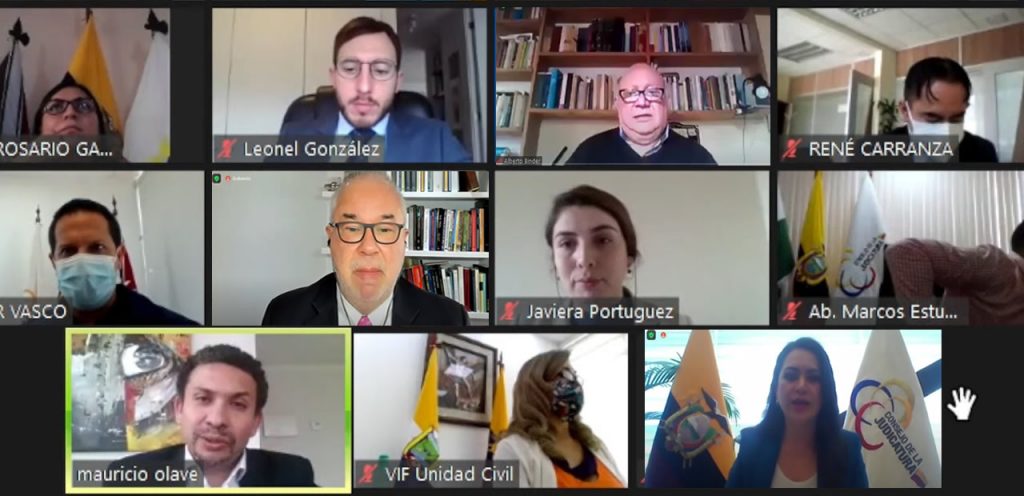
In addition, the entities held the seminar “Dialogue on Judicial Conduct and Ethics.”
The Justice Studies Center of the Americas (JSCA) and the Ecuadorean Judiciary Council signed a cooperation agreement on Friday, June 4.
The purpose of the cooperation agreement is to develop a joint work plan on justice, democracy and related topics that will create spaces for discussion and the exchange of experiences.
JSCA Executive Director Jaime Arellano reiterated the institution’s commitment to training the region’s justice representatives so that their preparation will be increasingly transparent and connected to the public.
“We are always assessing, studying and proposing multiple paths in order to ensure that every judge in Latin America has an appointment system based on profiles that are appropriate for each specific function,” he said.
Ecuadorean Judiciary Council President and JSCA Board member María del Carmen Maldonado Sánchez highlighted the importance of the agreement signed based on improved trust in justice, which in turn contributes to the strengthening of democracy.
“Dialogue on Judicial Conduct and Ethics”
After the Cooperation Agreement was signed, the seminar “Dialogue on Judicial Conduct and Ethics” took place.
María del Carmen Maldonado Sánchez, the President of Ecuador’s Judiciary Council, presented on “Challenges in the Context of the JSCA-Ecuadorean Judiciary Council Agreement.”
JSCA Training Director Leonel González presented a talk entitled “The Bangalore Principles as a Horizon for Technical Cooperation between JSCA and the Ecuadorean Judiciary Council.”
Next, Cristina San Juan, a member of the judicial integrity team of the Global Program for the Implementation of the Doha Declaration of the UN Office on Drugs and Crime, presented on “Judicial Integrity as a Pillar for the Implementation of the Doha Declaration.”
The President of INECIP Argentina, Alberto Binder, discussed “Judicial Government in Latin America: Overview and Perspectives.” Mauricio Olave, the President of the National Judges’ Association of Chile, presented the topic “The Importance of Judicial Government for Guaranteeing Judicial Independence: Lessons Learned Based on the Chilean Experience.”
Finally, Iván Saquicela, the President of the National Court of Ecuador, presented “Judicial Independence in Ecuador: Reality and Challenges.”