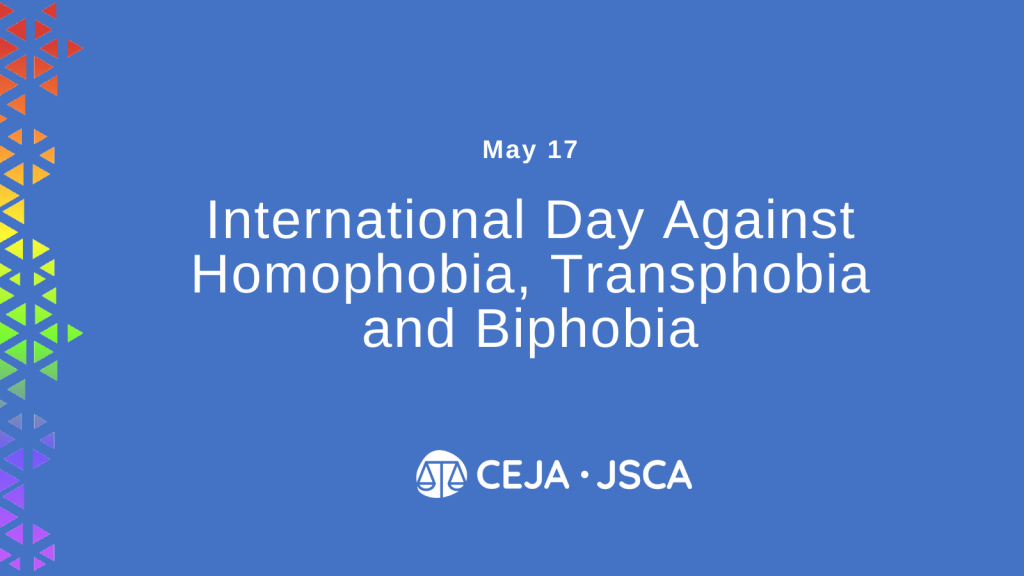
International Day Against Homophobia, Transphobia and Biphobia is held each year on May 17 to mark the World Health Organization (WHO) decision to eliminate homosexuality from its list of mental illnesses.
Over 30 years after this landmark decision was made, LGBTIQ+ people continue to be the victims of discrimination and violence in various spaces and spheres of daily life. The justice system is not removed from this. The persistence of stereotypes and biases that stand in the way of access to justice for LGBTIQ+ people should be a concern for all justice and government institutions.
Recognition of this group’s rights and categorical statements by the Inter-American Human Rights System regarding equality and non-discrimination are important steps forward, but are not sufficient.
One important milestone in this regard was the Inter-American Court of Human Rights ruling in the Case of Átala Riffo and Daughters v. Chile. In its ruling, the Court affirmed the living nature of human rights agreements and the need for their interpretation to evolve over time. It was emphatic that considering gender identity and sexual orientation constitutes prohibited motives for discrimination based on Article 1.1 of the American Convention on Human Rights. Specifically, paragraph 91 states: The Inter-American Court establishes that individuals’ sexual orientation and gender identity are categories protected by the Convention. Any discriminatory rule, act or practice based on a person’s sexual orientation is prohibited by the Convention (1).
More recently, the Inter-American Court ruled on discrimination against transgender people in the Case of Azul Rojas Marín et al. v. Peru, reiterating that States have an obligation to take positive steps to avoid or change situations of discrimination against a specific group of people (2).
The Court also has reiterated the symbolic aim of violence against LGBT people as a form of preventing or reversing the recognition, enjoyment or exercise of their rights in order to deliver a message of exclusion and subordination of those who challenge binary gender norms (3).
The latest report of the JSCA Observatory on Civil Conflict and Access to Justice (OCCA) discusses structural cisexism and heteronormativity as barriers to access to justice. According to the OCCA report, it is possible to identify specific barriers to access such as a lack of specialized legal aid programs, stereotypes and discriminatory attitudes on the part of justice system operators.
International Day Against Homophobia, Transphobia and Biphobia offers an important opportunity to reflect and make progress on positive actions that eradicate the discrimination and violence to which LGBTIQ+ individuals have historically been subjected. As the OCCA report states, the formal existence of rights for this group does not guarantee that they will actually be respected, as this involves an important cultural factor, which in turn requires awareness and training on gender issues for all system stakeholders (4).
____________
(1) I/A Court HR. Case of Átala Riffo and Daughters v. Chile Merits, Reparations and Costs. Ruling dated February 24, 2012, paragraphs 83-91.
(2) I/A Court HR. Case of Azul Rojas Marín et al. v. Peru. Preliminary Objections, Merits, Reparations and Costs. Ruling dated March 12, 2020, paragraph 89.
(3) I/A Court HR. Case of Azul Rojas Marín et al. v. Peru. Preliminary Objections, Merits, Reparations and Costs. Ruling dated March 12, 2020, paragraphs 90-92.
(4) Observatory on Civil Conflict and Access to Justice (2020). Civil Conflict and Barriers to Access to Justice in Latin America. Health Report. Santiago: Centro de Estudios de Justicia de las Américas/ Justice Studies Center of the Americas, p. 184.