
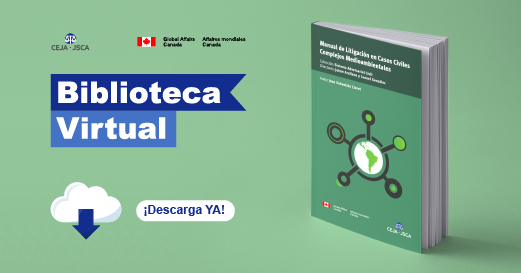
On Monday, April 19, the Justice Studies Center of the Americas (JSCA) published the Manual on litigating complex environmental civil cases written by Argentine professor Juan Sebastián Lloret.
The publication was launched during the virtual seminar “Environmental Civil Litigation in Latin America: Challenges and Vision” in the context of the project “Improving access to justice in Latin America,” which is financed by Global Affairs Canada (GAC).
The Manual on litigating complex environmental civil cases is a new tool for justice operators and environmental human rights defenders in Latin America and the Caribbean.
The manual presents essential elements for understanding the basis for environmental cases, tools that can be used to manage them and practical examples for litigations and judicial responses.
The text, which contains just over 150 pages, presents the whys, how and what of handling environmental disputes with a strategic and comprehensive perspective on the current lines of work in environmental defense on the American sub-continent.
The Escazú Agreement
The manual’s publication coincides with important developments related to the Escazú Regional Agreement on Access to Information, Public Participation and Access to Justice in Environmental Matters in Latin America and the Caribbean, which entered into force on April 22, 2021. This pact redefines environmental governance obligations vis-a-vis the justice system and the risks and impacts of ecological and social safety.
The document focuses on the processing of complex and structural environmental cases and organizes and distributes guarantees of collective environmental due process that govern access to the environmental response in the context of the new agreement. To that end, it includes explanatory tables and discussions of the essential elements of various issues to be considered in legal work oriented towards an oral and adversarial profile in the current system.
Challenges such as strategic case planning and its obverse, judicial case management and evidence problems, the definition of the legal propositions of claim and response, argument discourse and the use of environmental law principles, effective judicial protection and protective measures, alternative outcomes, remedial sentences and forms of appealing judicial decisions are discussed in the text.
The Manual on litigating complex environmental civil cases will provide justice operators and environmental human rights defenders in Latin America and the Caribbean a rapid and comprehensive path to understanding environmental civil cases, how to handle them and how to resolve them.
We invite you to download the Manual on litigating complex environmental civil cases.