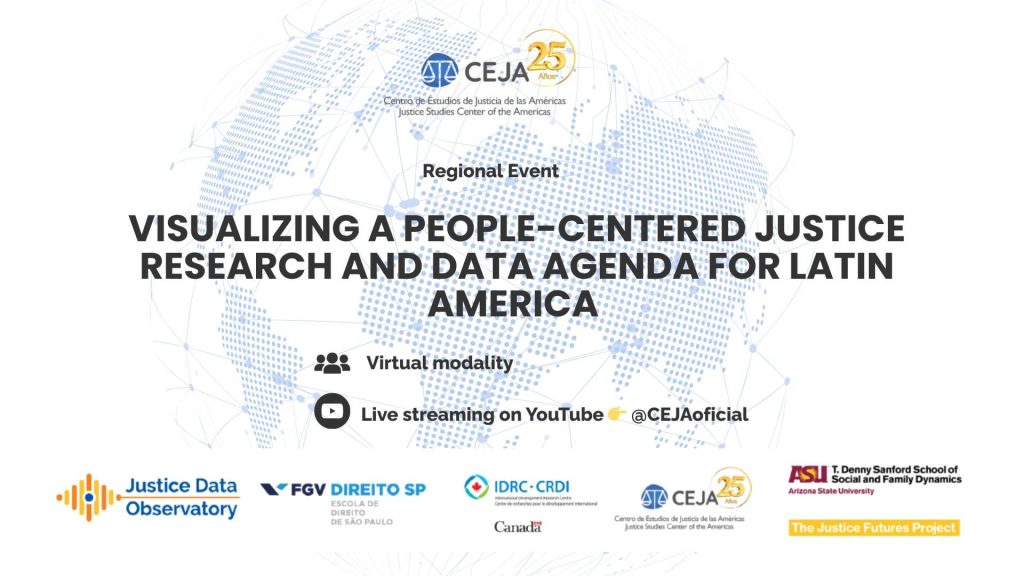
The Justice Studies Center of the Americas (CEJA) invites you to take part in the event “Visualizing a People-Centered Justice Research and Data Agenda for Latin America,” which will take place on Monday, August 25, 2025, from 9:00 a.m. to 5:30 p.m. (Brazil time) at the FGV São Paulo Law School (Escola de Direito da Fundação Getúlio Vargas). The event will be livestreamed on our YouTube channel (@cejaoficial) with simultaneous interpretation into Portuguese, Spanish, and English.
People-centered justice is conceived as a new public policy paradigm. It starts from the idea that legal problems are common, diverse, and everyday experiences—often rendered invisible by traditional justice systems, which tend to organize themselves around institutional structures rather than the real needs of those who require their services.
This approach proposes designing institutions, programs, and services based on empirical knowledge of how people experience their legal problems and the obstacles they face in exercising their rights.
📅 Event Agenda
Visualizing a People-Centered Justice Research and Data Agenda for Latin America
📍 São Paulo, FGV Law School
🗓️ Monday, August 25, 2025
🕘 9:20 a.m. – 5:30 p.m. (Brazil time)
🕗 8:20 a.m. – 4:30 p.m. (Chile time)
🕖 7:20 a.m. – 2:30 p.m. (Colombia / Peru time)
🎥 Join the livestream on our YouTube channel: @cejaoficial
9:20 a.m. | Opening Remarks
9:30 – 11:00 a.m. | Data and Evidence for People-Centered Justice
- Gustavo Maurino, Professor, Torcuato Di Tella University; Director of ELAC (Argentina)
- Rebecca Sandefur, Professor, Arizona State University; American Bar Foundation (USA)
- Julia dos Santos Drummond, Professor, FGV São Paulo Law School (Brazil)
Moderator: Daniela Gabbay, Professor, FGV São Paulo Law School (Brazil)
11:30 a.m. – 1:00 p.m. | Evidence-Based Interventions in Latin America
- Ricardo Lillo, Professor and Director, People-Centered Justice Lab, Universidad Adolfo Ibáñez (Chile)
- Sebastián Pilo, Lawyer, University of Buenos Aires; Consultant, Latin American Network for Grassroots Justice (Argentina)
- Cecília Asperti, Professor, FGV São Paulo Law School (Brazil)
- Danieli Rocha Chiuzuli, Ph.D. Candidate, FGV São Paulo Law School (Brazil)
Moderator: Matthew Burnett, Director of Research and Programs, American Bar Foundation (USA)
2:00 – 3:30 p.m. | People-Centered Justice and Institutional Reform in Latin America
- Federico Chunga, Research Consultant at CEJA (Peru)
- Mateo Vásquez, Research Consultant at CEJA (Colombia)
- Luciana Gross Cunha, Professor, FGV São Paulo Law School (Brazil)
Moderator: Lorena Espinosa, Director of Studies and Training at CEJA (Chile)
4:00 – 5:30 p.m. | Whose Access? People-Centered Justice and Specific Populations
- Denise Dora, Human Rights Lawyer, PPG Public Policies, UFRGS (Brazil)
- Lorena Espinosa, Director of Studies and Training at CEJA (Chile)
- Fernando Shecaira, Professor, FGV São Paulo Law School (Brazil)
- Rebecca Lemos Igreja, Secretary General, Latin American Faculty of Social Sciences (Brazil)
Moderator: Gustavo Maurino, Professor, Torcuato Di Tella University; Director of ELAC (Argentina)
This event aims to launch a regional research and data agenda for people-centered justice, strengthening dialogue among academia, governments, and civil society to advance more accessible, inclusive, and effective justice systems in Latin America.
🤝 This event is made possible thanks to the collaboration of:
- Justice Data Observatory
- São Paulo Law School – Fundação Getúlio Vargas (FGV Direito SP)
- International Development Research Centre (IDRC/CRDI) – Canada
- Justice Studies Center of the Americas (CEJA)
- Arizona State University – T. Denny Sanford School of Social and Family Dynamics
- The Justice Futures Project
📺 Join the livestream on our YouTube channel: @cejaoficial