“Ways to resolve civil and family conflicts and their effectiveness in Colombia and Peru” (IDRC – JSCA)

Throughout 2023, two JSCA consulting teams formed by Mateo Vasquez Echeverri, Samed Mateo Vargas Montero, Leonardo García and Lizeth Johanna Ñungo Pérez (Colombia) and the Former Minister of Justice and Human Rights Eduardo Vega Luna, Federico Chunga Fiestas and Cristell Paola Casani Apaza (Peru) have traveled to six locations in these countries to meet with officials from conciliation centers, with the aim of reflecting and analyzing the different judicial and non-judicial solutions that exist for the resolution of family and marriage conflicts. living place.
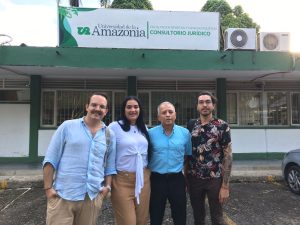
This territorial deployment is carried out within the framework of the project “Ways to resolve civil and family conflicts and their effectiveness in Colombia and Peru”, promoted by the International Development Research Center (IDRC).
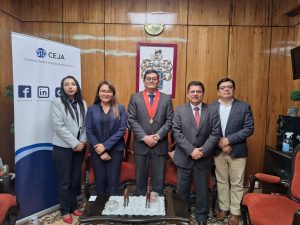
The teams have been in Barranquilla, Bogotá and Florencia, Iquitos, Lima and Arequipa, visiting conciliation centers, Superior Courts of Justice and judicial institutions, where professionals and users have been interviewed.

Noticias relacionadas:

The Justice Studies Center of the Americas (JSCA/CEJA) successfully concluded the second edition of its regional program, “Artificial Intelligence and Justice Systems: Ethical Perspectives, Regulations, and International Experiences,” an initiative that brought together more than 40 participants from across the region interested in understanding the impact of artificial intelligence (AI) on the administration of justice.
Across the Americas, transforming justice remains one of the greatest challenges of our time. It is not only about modernizing institutions, but also about building systems that are more efficient, inclusive, and people-centered. 
On April 21, the final session of the course “Investigating Corruption by Following the Money” was held at the Office of the Director of Public Prosecutions in Trinidad and Tobago, marking the conclusion of this specialized training in the country. 
Regional cooperation on justice and citizen participation continues to advance through a new meeting led by the Organization of American States, which brought together in Chile the Center for the Study of Justice of the Americas with civil society organizations, academia, and justice system stakeholders.
On April 17, the Justice Studies Center of the Americas (JSCA) held the closing session of the course “Improving Criminal Prosecution in Cases of Gender-Based Violence in Trinidad and Tobago”, marking the completion of this specialized training programme.