
CEJA Launches Regional Program for Central America on Corruption Investigation and Tracing Illicit Money

The Justice Studies Center of the Americas (CEJA) has launched its specialized training program

The Justice Studies Center of the Americas (CEJA) has launched its specialized training program, “Investigating Corruption by Following the Money,” aimed at prosecutors and judges from Costa Rica, Guatemala, El Salvador, Honduras, and Panama. The program seeks to strengthen their professional skills in financial criminal investigations.
This CEJA program is being developed in partnership with the German Ministry of Foreign Affairs and aims to provide Central American prosecutors and judges with enhanced tools to combat corruption more effectively. The training covers topics such as economic crimes, the investigation of economic criminality, forensic auditing, and asset forfeiture.

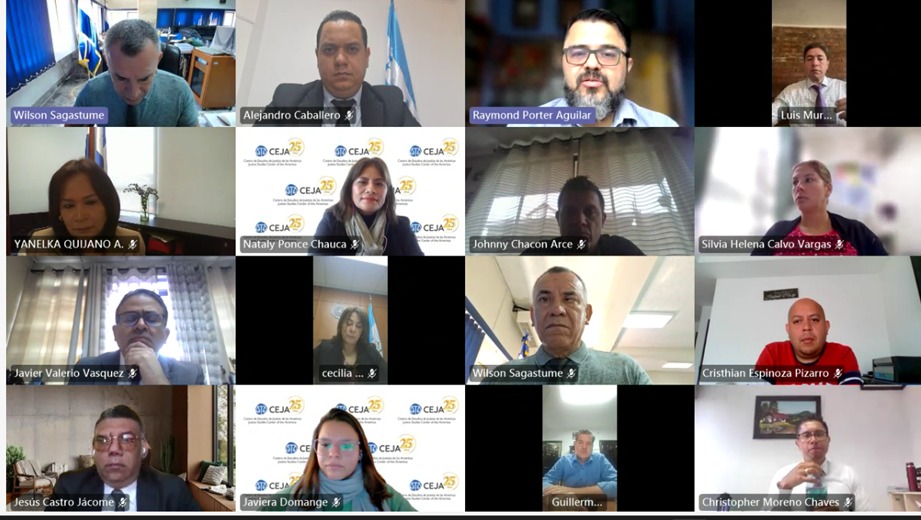
The program began with a Virtual Welcome Meeting for participants, which included the participation of Cecilia Barrios, CEJA Advisor; Nataly Ponce, Executive Director of CEJA; Rebeca Guardia, Director of the Judicial School of the Judiciary of Costa Rica; and Javiera Domange, CEJA researcher.

Cecilia Barrios and Rebeca Guardia emphasized the importance of this training in addressing the complex challenges posed by organized crime and corruption in Central America.

A Regional Commitment Against Corruption

At CEJA, we reaffirm our commitment to the ongoing and specialized training of justice operators, recognizing the value of regional collaboration in addressing corruption from a technical and comparative perspective.

With this new edition in Central America, CEJA continues to expand its impact and leadership in building specialized capacities to tackle central challenges in Latin America, such as corruption and organized crime.

Noticias relacionadas:

The Justice Studies Center of the Americas (CEJA) will carry out a study aimed at identifying and analyzing the main critical bottlenecks that arise in the application of Law No. 21.675, which establishes standards to prevent, punish, and eradicate violence against women based on gender, with a particular focus on its implementation within the Chilean Courts of Justice.
On Friday, November 28, CEJA’s Executive Director, Nataly Ponce, and the Coordinator of Studies and Training, Rodrigo Nakada, held a working meeting with Diego Oliveira Silva, Director General of the National School of the Public Defender’s Office of the Union (DPU) of Brazil.
The Justice Studies Center of the Americas (CEJA) participated in the International Workshop “Interculturality Approach in Policies for Afro-Descendant Populations”, organized by the Technical Secretariat of the Inter-American Network of High Authorities for Afro-Descendant Populations (RIAFRO) of the Organization of American States (OAS).
On November 19, the International Seminar on the Dissemination of the Case Management Protocol was held in Panama City, marking a key milestone in the process of modernizing Panama’s civil justice system. The initiative was jointly promoted by Panama’s Judicial Branch and the Justice Studies Center of the Americas (CEJA).
The Justice Studies Center of the Americas (CEJA) will launch on October 28 in Ecuador the Specialized Program “Governance and Modern Management of High Jurisdictional Courts”, developed in partnership with the National Court of Justice of Ecuador and the International Italo-Latin American Organization (IILA), within the framework of the FIEDS/ITAJUS project.
The Justice Studies Center of the Americas (CEJA) presented to the Committee on Juridical and Political Affairs (CAJP)