CEJA and the IACHR Strengthen Inter-Institutional Cooperation to Promote Access to Justice in the Americas

In a key meeting to strengthen justice systems in the region, representatives from the Justice Studies Center of the Americas (CEJA) and the Inter-American Commission on Human Rights (IACHR) explored new avenues for collaboration in the coming years.
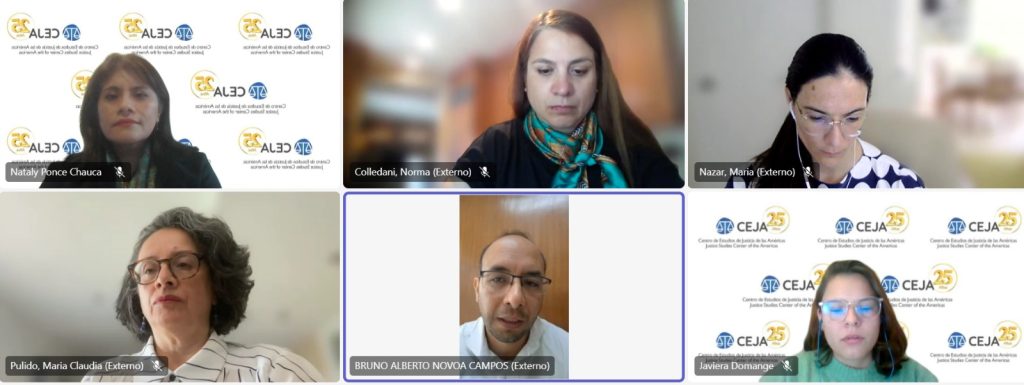
During the meeting, strategic topics such as training on justice reform and efforts for joint capacity-building from a regional perspective were highlighted.

The IACHR particularly valued the possibility of participating in promotional and training initiatives, as well as accessing technical information produced by CEJA. Both institutions agreed on the importance of planning a joint roadmap for 2025–2026 that includes preparatory activities, knowledge generation, and the strengthening of public policies with a human rights focus.

This working meeting is framed within Resolution AG/RES. 3029 of the General Assembly of the Organization of American States (OAS), which establishes the design of a Collaborative Roadmap between CEJA and the OAS to increase the visibility of our institution and promote joint work with other OAS bodies.

Participants included Bruno Novoa, Chair of the CEJA Board of Directors; Board Member Cecilia Barrios; CEJA Executive Director Nataly Ponce; and researcher Javiera Domange. From the IACHR, María Claudia Pulido, IACHR Deputy Executive Secretary, and officials Norma Colledani and María Clara Nazar took part.

Noticias relacionadas:

The Justice Studies Center of the Americas (CEJA/JSCA) is launching a participatory process to define the priorities that will guide its work over the next four years. We want to hear from those who wish to contribute with their perspectives and experiences on justice in the region. 
The Justice Studies Center of the Americas (CEJA) and the Master’s Program in Law (LLM UC) at the Faculty of Law of the Pontifical Catholic University of Chile have signed a framework cooperation agreement aimed at strengthening academic research, student training, and the development of joint initiatives focused on the reform and modernization of justice systems across the region.
At the 56th General Assembly of the Organization of American States (OAS), the Member States elected Patricia Elizabeth Gámez (Guatemala) and Santiago Pereira Campos (Uruguay) as new members of the Board of Directors of the Justice Studies Center of the Americas (CEJA/JSCA).
The Justice Studies Center of the Americas (JSCA/CEJA) successfully concluded the second edition of its regional program, “Artificial Intelligence and Justice Systems: Ethical Perspectives, Regulations, and International Experiences,” an initiative that brought together more than 40 participants from across the region interested in understanding the impact of artificial intelligence (AI) on the administration of justice.
Across the Americas, transforming justice remains one of the greatest challenges of our time. It is not only about modernizing institutions, but also about building systems that are more efficient, inclusive, and people-centered.