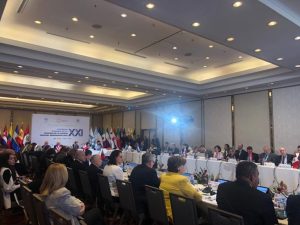
 After nine years, the Justice Studies Center of the Americas once again participated in the XXI edition of the Ibero-American Judicial Summit held in Lima, Peru. The Plenary Assembly was held between September 20 and 22, 2023 and brought together high level authorities of the judiciaries of Latin America and the Caribbean.
Some of the most important issues discussed at the event included the gender perspective integrated throughout the work of the Judicial Branches; ensuring equality and non-discrimination in access to justice for all people. In line with this, the Judicial Branches were urged to implement mechanisms that promote equal participation for all women who work at these institutions.
The summit included four working groups that addressed topics such as best practices in inclusion and intersectionality in the judicial career, evaluation of judicial performance with a health and welfare perspective, proposals for best practices manuals on disciplinary rules in the judicial career and the proposal of a code of ethics to guarantee fundamental rights and values of justice in the use of artificial intelligence.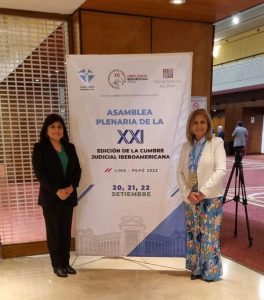
The reports of the standing committees, which deal with issues such as alternative dispute resolution mechanisms, drug treatment courts, gender and access to justice, environmental justice, and judicial ethics were also presented.
JSCA Executive Director Nataly Ponce spoke with members of Peru’s National Justice Board and with delegations from Colombia, Mexico, Paraguay, the Dominican Republic, Costa Rica, and Spain about strengthening access to justice. The authorities of all the delegations were also presented with JSCA’s training offerings and strategic plan. María Victoria Rivas, President of JSCA’s Board of Directors, spoke at the plenary and emphasized the priority areas of our organization.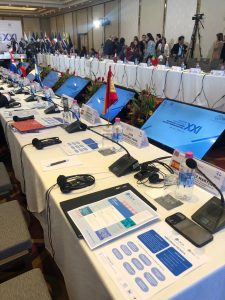
JSCA thanks Minister John Pérez Brignani, Permanent Secretary of the Ibero-American Judicial Summit and Minister of the Supreme Court of Justice of Uruguay, and Dr. Javier Arévalo Vela, Secretary pro tempore of the XXI Edition of the summit and President of the Supreme Court of Justice of the Republic of Peru, for facilitating JSCA’s return to the summit. JSCA congratulates the Presidency of the Judicial Branch of the Dominican Republic for its designation as the new Pro Tempore Secretary, to which we hope to offer future collaboration and technical support.
Our special thanks to Dr. Mariem De La Rosa Bedriñana, Supreme Judge of the Supreme Court of Justice of Peru.