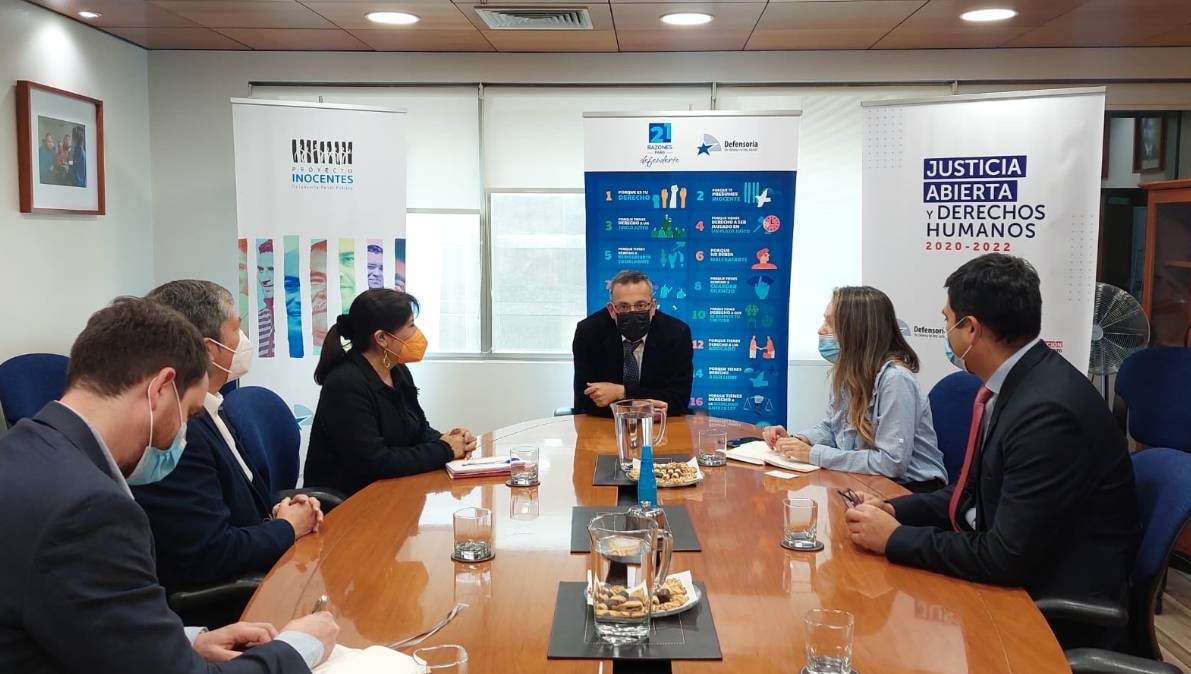
On September 12, 2022, JSCA’s Executive Director, Nataly Ponce, along with the Director of Technical Assistance, Open and Digital Justice, Cristian Hernández, and the Director of Studies, Gherman Welsch, held a meeting with the National Public Defender of Chile, Carlos Mora, his Chief of Staff Claudia Vergara and the Chief of Studies of the Ombudsman’s Office, Pablo Aranda.
JSCA’s Executive Director presented the JSCA Strategic Plan 2022-2026, emphasizing the priority issues that are directly related to the work of the Chilean Public Defender’s Office. The possibility of JSCA contributing to the management of the Public Defender’s Office through, for example, open justice and digital transformation initiatives, the use of artificial intelligence, training and collaboration as a technical body on bills involving the Chilean criminal justice system was also highlighted.
The importance of a gender and intersectionality perspective was also discussed, as well as the different initiatives that the Public Defender’s Office has in the defense of groups in vulnerable situations, such as women, migrants and indigenous people. For its part, the Public Defender’s Office expressed its willingness to share the research it has carried out on the subject.
Likewise, the National Public Defender commented on institutional priorities, highlighting the need to move towards institutional autonomy as one of the fundamental pillars to strengthen the role of the public defender’s office. In addition, priorities were defined as the implementation of initiatives to improve the attention of users through the development of various channels of attention and to continue advancing in training, especially in aspects related to specialized defense.
Finally, both institutions agreed to work together and to disseminate the experience of the Chilean Public Defender’s Office to other Latin American and Caribbean countries through study visits that will allow them to learn about its operation.
The Justice Studies Center of the Americas (JSCA) is an inter-governmental agency with technical and operational autonomy that was established by resolution of the General Assembly of the Organization of American States (OAS) in fulfillment of the mandates of the Plan of Action of the Second Americas Summit (Santiago, April 1998) and the recommendations adopted during the Meetings of Ministers of Justice or Other Ministers , Prosecutors, and Attorneys General of the Americas (REMJA).
JSCA provides technical assistance to governments, judicial branches, public prosecution services, and other justice institutions; develops technical studies and generates empirical evidence; facilitates the exchange of information and best practices at the regional level; and provides specialized training to justice sector operators and public policymakers in the countries of the Americas.