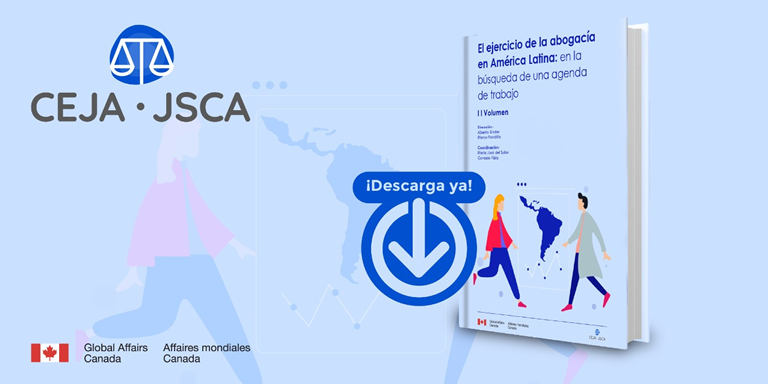
In an effort to continue to expand the perspective on the role of attorneys in the region in regard to access to justice and to contribute to the development of public policies designed to eliminate the barriers to access that persist in some countries, JSCA presents the publication “The Practice of Law in Latin America: In Search of an Agenda, Volume 2.”
The publication presents four studies that revisit some of the topics presented in Volume 1 and introduce other perspectives that are particularly important for the practice of law in the region.
The first, “Professional Skills for Oral Civil Procedures: University Training for the Practice of Law, The Case of Córdoba,” by Carolina Granja and Damián Pertile, explores the professional skills needed to practice in a civil justice system that has moved towards the use of oral procedures and whether those skills are currently part of university training.
The second, “Attorneys’ Fees: Lessons, Challenges and Problems to Be Addressed,” by Uruguayan Professor Ignacio Soba Bracesco, reviews regulations on attorneys’ fees, analyzing the aspects introduced by Uruguay’s civil procedure reform. The study also presents a comparative perspective on the regulations in place in Chile and Brazil.
In the third piece, “The Practice of Law, Information and Communications Technologies (ICTs) and Access to Justice: An Initial Study of the Context in Chile,” Carolina Salas Salazar, Katherine Becerra, Jorge Bruce and Yelissa Rojo discuss how the country’s legal studies have adapted to the transformation of the digital environment in the process of imparting justice following the passage of Law 20.886 of 2015 on Digital Processing of Judicial Proceedings.
Finally, María Fernanda Arreguín Gámez presents the study “The Practice of Law in the Area of Civil Public Defense: Mexico as a Case Study.” The author explores the practice of public law in that country and how it allows at-risk individuals to access the justice system.
The publication “The Practice of Law in Latin America: In Search of an Agenda, Volume 2” is one of the results of the program Improving Access to Civil Justice in Latin America, which JSCA is developing with the support of Global Affairs Canada.
Click here to download the publication.