JSCA presents the research project: “Indigenous justice and ordinary justice responses to civil disputes: The path towards alignment”

On Friday, the Justice Studies Center of the Americas (JSCA) will present the publication “Indigenous justice and ordinary justice responses to civil disputes: The path towards alignment”, which was written by consultant Silvina Ramírez.
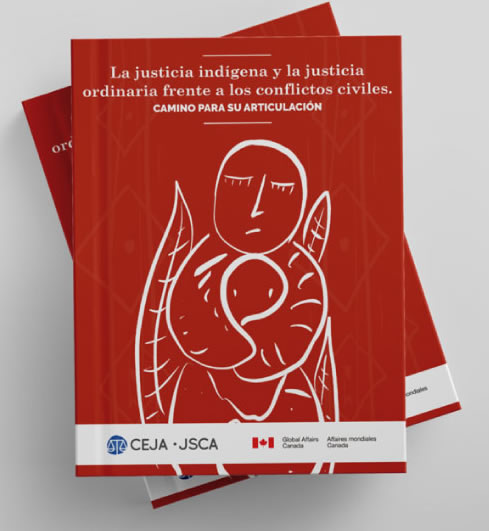
The publication reviews the evolution of the recognition of the region’s indigenous justice systems and experiences related to their co-existence with non-indigenous systems (regulatory laws or delegation to higher-level justice agencies).

The author focuses on civil justice and identifies obstacles related to conceptualizing the term ‘indigenous justice’ based on traditional legal traditions that may not align with key characteristics of indigenous law, such as its use of oral procedures, dynamism, and lack of compartmentalization by area.

The publication “Indigenous justice and ordinary justice responses to civil disputes: The path towards alignment” was made possible by the financial support of Global Affairs Canada (GAC) as part of the project “Improving Access to Civil Justice in Latin America,” which JSCA has been executing for the past six years.

For more information on the publication, see

Noticias relacionadas:

The Justice Studies Center of the Americas (JSCA/CEJA) successfully concluded the second edition of its regional program, “Artificial Intelligence and Justice Systems: Ethical Perspectives, Regulations, and International Experiences,” an initiative that brought together more than 40 participants from across the region interested in understanding the impact of artificial intelligence (AI) on the administration of justice.
Across the Americas, transforming justice remains one of the greatest challenges of our time. It is not only about modernizing institutions, but also about building systems that are more efficient, inclusive, and people-centered. 
On April 21, the final session of the course “Investigating Corruption by Following the Money” was held at the Office of the Director of Public Prosecutions in Trinidad and Tobago, marking the conclusion of this specialized training in the country. 
Regional cooperation on justice and citizen participation continues to advance through a new meeting led by the Organization of American States, which brought together in Chile the Center for the Study of Justice of the Americas with civil society organizations, academia, and justice system stakeholders.
On April 17, the Justice Studies Center of the Americas (JSCA) held the closing session of the course “Improving Criminal Prosecution in Cases of Gender-Based Violence in Trinidad and Tobago”, marking the completion of this specialized training programme.