JSCA, Ecuadorian Judiciary Council and Ibero-American Judicial Summit organize Ibero-American Virtual Meeting of Judges with Technology against Violence

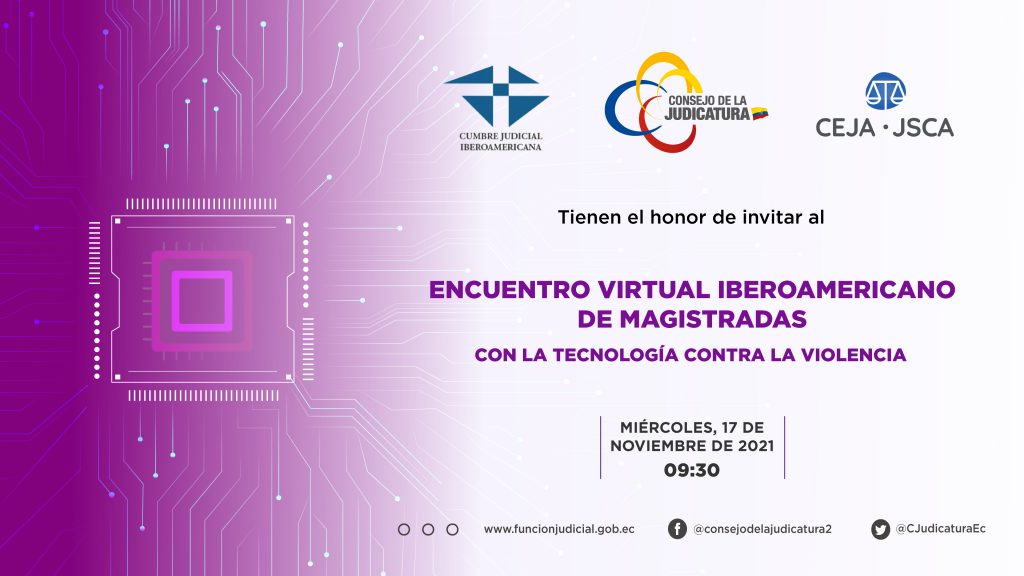
The Justice Studies Center of the Americas (JSCA), Ecuadorian Judiciary Council and the Ibero-American Judicial Summit will hold a Virtual Meeting of Judges with Technology against Violence on Wednesday, November 17

The virtual meeting will begin at 9:30 a.m. (Ecuador). Its purpose is to highlight the actions undertaken by various judges in Ibero-America to protect rights through effective use of new technologies.

The activity will feature the participation of Dr. Teresa Féria, a justice on Portugal’s Supreme Court, Dr. María del Carmen Maldonado, the President of the Ecuadorian Judicial Council, and JSCA researcher Dr. Laura Cora.

 Click here to register for the event. 

Noticias relacionadas:

The Justice Studies Center of the Americas (CEJA/JSCA) is launching a participatory process to define the priorities that will guide its work over the next four years. We want to hear from those who wish to contribute with their perspectives and experiences on justice in the region. 
The Justice Studies Center of the Americas (CEJA) and the Master’s Program in Law (LLM UC) at the Faculty of Law of the Pontifical Catholic University of Chile have signed a framework cooperation agreement aimed at strengthening academic research, student training, and the development of joint initiatives focused on the reform and modernization of justice systems across the region.
At the 56th General Assembly of the Organization of American States (OAS), the Member States elected Patricia Elizabeth Gámez (Guatemala) and Santiago Pereira Campos (Uruguay) as new members of the Board of Directors of the Justice Studies Center of the Americas (CEJA/JSCA).
The Justice Studies Center of the Americas (JSCA/CEJA) successfully concluded the second edition of its regional program, “Artificial Intelligence and Justice Systems: Ethical Perspectives, Regulations, and International Experiences,” an initiative that brought together more than 40 participants from across the region interested in understanding the impact of artificial intelligence (AI) on the administration of justice.
Across the Americas, transforming justice remains one of the greatest challenges of our time. It is not only about modernizing institutions, but also about building systems that are more efficient, inclusive, and people-centered.