Join us on July 20 at 3:00 p.m. Paraguay-Chile time.
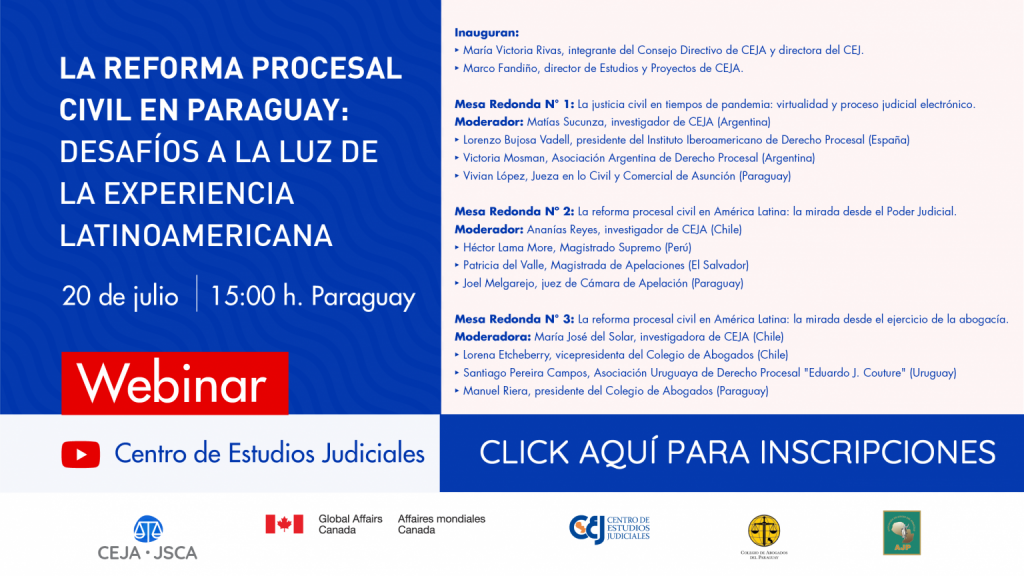
The Justice Studies Center of the Americas (JSCA), the Judicial Research Center (CEJ), the Paraguayan Bar Association and the Paraguayan Judges’ Association invite all members of the public to participate in the webinar “Civil Procedure Reform in Paraguay: Challenges in Light of the Latin American Experience,” which will be held July 20 at 3 p.m.
JSCA Research and Projects Director Marco Fandiño explains that the activity provides an opportunity to promote civil procedure reform in Paraguay.
“Paraguay is one of the only countries in Latin America that has not undertaken a profound reform of its civil justice system by incorporating oral procedures. Access to justice for everyday conflicts that do not reach the justice system should be addressed by putting the population’s legal needs at the center of the reform process,” he noted.
MARCO FANDIÑO, JSCA RESEARCH AND PROJECTS DIRECTOR
María Victoria Rivas, the Executive Director of the Judicial Research Center (CEJ) stated that, “Paraguay’s Civil Procedure Code dates back to 1988. Changes have been made, but an in-depth discussion did not occur in light of the Constitution of 1992.”
“Now is the time to discuss principles such as the use of oral procedures and immediacy and to incorporate mechanisms that guarantee effective judicial protection,” she adds.
MARÍA VICTORIA RIVAS, EXECUTIVE DIRECTOR OF THE CENTER FOR JUDICIAL STUDIES
The activity, which will be broadcast via the YouTube Channel of the Center for Judicial Research, will consist of three roundtable discussions that will feature experts from Argentina, Spain, Paraguay, Chile, Peru, El Salvador and Uruguay.
Round-table Discussions
The first roundtable discussion, “Civil Justice in Times of Pandemic: Virtual Proceedings and Electronic Judicial Process,” will be moderated by JSCA researcher Matías Sucunza and will also include Lorenzo Bujosa, the President of the Ibero-American Procedure Law Institute; Victoria Mosman of the Agentine Procedure Law Association; and the Honorable Vivian López, a civil and commercial court judge in Asunción.
The second roundtable discussion, “Civil Procedure Reform in Latin America: The Perspective of the Judiciary,” will be moderated by JSCA researcher Ananías Reyes. She will be joined by Supreme Court Justice Héctor Lama, Appeals Court Judge Patricia del Valle and Appeals Chamber Judge Joel Melgarejo.
The third and final roundtable discussion,“Procedure Reform in Latin America: The Perspective of the Practice of Law,” will be moderated by JSCA researcher María José del Solar and will include Lorena Etcheberry, the Vice President of the Chilean Bar Association; Santiago Pereira Campos, a member of the Eduardo J. Couture Uruguayan Procedure Law Association; and Manuel Riera, the President of the Paraguayan Bar Association.
Click here to register.