JSCA co-organizes colloquium with UCASAL entitled “Arraignment and Evidentiary Law” in Argentina

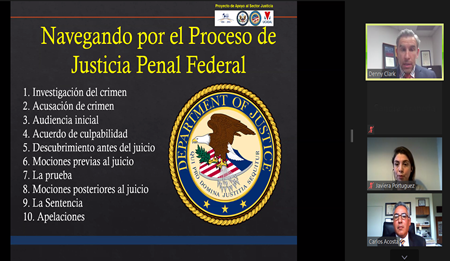
The Justice Studies Center of the Americas (JSCA) co-organized the colloquium “Arraignment and Evidentiary Law” with the Universidad Católica de Salta (UCASAL) Law School on Thursday, May 6.

The activity was mainly attended by justice system operators from the Judicial Branch, Public Prosecutor’s Office and Public Defender’s Office from the Salta and Jujuy federal and local justice systems. It also included members of Uruguay’s justice system.

American University Washington College of Law faculty members Carlos Acosta, a district court judge from Maryland, and Dennis Clark, a prosecutor from Washington, D.C., presented a case study and overview of the US criminal justice system.

They also discussed and compared the rules of evidentiary admissibility of the US, Argentinean and Uruguayan criminal justice systems.

The virtual colloquium was part of the project “The implementation of an adversarial federal justice system in Argentina,” which JSCA is executing with funds from the US Embassy in Argentina’s International Narcotics and Law Enforcement (INL) agency. Its purpose is to provide technical support for the implementation of a new federal criminal procedure code in Argentina.

Noticias relacionadas:

The Justice Studies Center of the Americas (JSCA/CEJA) successfully concluded the second edition of its regional program, “Artificial Intelligence and Justice Systems: Ethical Perspectives, Regulations, and International Experiences,” an initiative that brought together more than 40 participants from across the region interested in understanding the impact of artificial intelligence (AI) on the administration of justice.
Across the Americas, transforming justice remains one of the greatest challenges of our time. It is not only about modernizing institutions, but also about building systems that are more efficient, inclusive, and people-centered. 
On April 21, the final session of the course “Investigating Corruption by Following the Money” was held at the Office of the Director of Public Prosecutions in Trinidad and Tobago, marking the conclusion of this specialized training in the country. 
Regional cooperation on justice and citizen participation continues to advance through a new meeting led by the Organization of American States, which brought together in Chile the Center for the Study of Justice of the Americas with civil society organizations, academia, and justice system stakeholders.
On April 17, the Justice Studies Center of the Americas (JSCA) held the closing session of the course “Improving Criminal Prosecution in Cases of Gender-Based Violence in Trinidad and Tobago”, marking the completion of this specialized training programme.