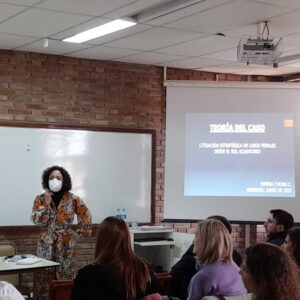
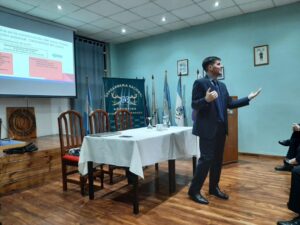
 As part of its efforts to strengthen reform processes in the region with a focus on training justice system operators, the Justice Studies Center of the Americas (JSCA) held a training program from June 27 to July 1, 2022 in Mendoza. The effort is part of the project to support criminal procedure reform in Argentina and the strengthening of the transition to the adversarial system. The project is financed by the International Narcotics and Law Enforcement agency (INL) through the US Embassy in Argentina.
The training program consisted of a course for prosecutors and assistant prosecutors focused on providing tools for developing litigation skills, particularly those that may be useful during pretrial hearings.
A training course was also held for federal prosecution service officials and employees. It was focused on providing tools for the development of management skills, the analysis of primary and secondary work processes in prosecution services, and their connection to law enforcement and services for victims and witnesses.
Finally, a workshop was held to train law enforcement officials on gathering evidence and its impact at oral trial.
The Justice Studies Center of the Americas (JSCA) is an inter-governmental agency with technical and operational autonomy that was established by resolution of the General Assembly of the Organization of American States (OAS) in fulfillment of the mandates of the Plan of Action of the Second Americas Summit (Santiago, April 1998) and the recommendations adopted during the Meetings of Ministers of Justice or Other Ministers, Prosecutors, and Attorneys General of the Americas (REMJA).
JSCA provides technical assistance to governments, judicial branches, public prosecution services, and other justice institutions; develops technical studies and generates empirical evidence; facilitates the exchange of information and best practices at the regional level; and provides specialized training to justice sector operators and public policymakers in the countries of the Americas.