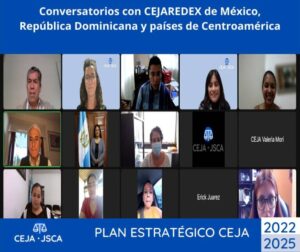
 The Justice Studies Center of the Americas (JSCA) held the first discussion as part of the participatory development of its 2022-2025 Strategic Plan on April 25, 2022. The event featured the participation of over 20 members of the JSCA Alumni Network from Mexico, the Dominican Republic and Central America.
JSCA’s subregional discussions are part of a broad participatory process designed to discuss the main challenges, issues, tools, lines of action and spaces for collaboration on the work that the Center will conduct in the coming years with key stakeholders. JSCA will use the subregional perspective to address the specific priorities and challenges of subregions in the American continent.
The first subregional discussion featured the participation of members of justice system institutions, representatives of civil society organizations and the academic sector and other JSCA Alumni Network members from Mexico, the Dominican Republic, Guatemala, Honduras, El Salvador, Costa Rica, Nicaragua and Panama.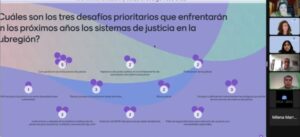
JSCA Executive Director Nataly Ponce thanked the participants for their valuable contributions to the discussion, which address key questions that will help identify the Center’s medium-term goals, objectives and thematic agenda.
Finally, JSCA reiterates its invitation to all interested institutions and operators to participate in the development of the 2022-2025 Strategic Plan by taking part in the Virtual Consultation, which will be available online until May 11.