JSCA presents the research project: “Indigenous justice and ordinary justice responses to civil disputes: The path towards alignment”

On Friday, the Justice Studies Center of the Americas (JSCA) will present the publication “Indigenous justice and ordinary justice responses to civil disputes: The path towards alignment”, which was written by consultant Silvina Ramírez.
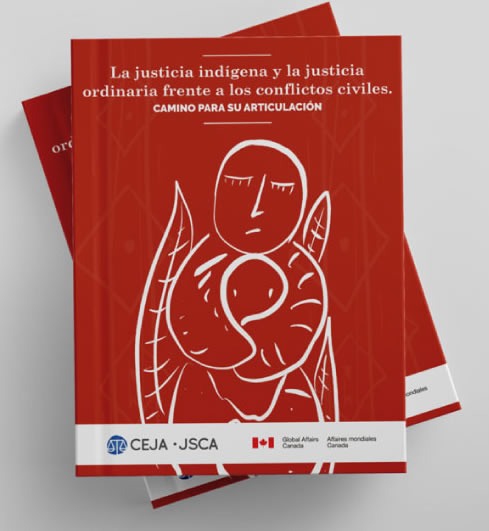
The publication reviews the evolution of the recognition of the region’s indigenous justice systems and experiences related to their co-existence with non-indigenous systems (regulatory laws or delegation to higher-level justice agencies).

The author focuses on civil justice and identifies obstacles related to conceptualizing the term ‘indigenous justice’ based on traditional legal traditions that may not align with key characteristics of indigenous law, such as its use of oral procedures, dynamism, and lack of compartmentalization by area.

The publication “Indigenous justice and ordinary justice responses to civil disputes: The path towards alignment” was made possible by the financial support of Global Affairs Canada (GAC) as part of the project “Improving Access to Civil Justice in Latin America,” which JSCA has been executing for the past six years.

For more information on the publication, see

Noticias relacionadas:

The Federal Institute of Public Defense (Instituto Federal de Defensoría Pública – IFDP) and the Justice Studies Center of the Americas (Centro de Estudios de Justicia de las Américas – CEJA) have signed a Memorandum of Understanding to promote research, training, and joint initiatives aimed at reducing inequalities and strengthening access to justice for priority groups.
The debate over how to regulate children’s and adolescents’ access to social media poses significant challenges for legal systems: how can their protection in digital environments be ensured while recognizing their evolving capacities to exercise rights and make decisions? 
The Justice Studies Center of the Americas (CEJA/JSCA) is launching a participatory process to define the priorities that will guide its work over the next four years. We want to hear from those who wish to contribute with their perspectives and experiences on justice in the region. 
The Justice Studies Center of the Americas (CEJA) and the Master’s Program in Law (LLM UC) at the Faculty of Law of the Pontifical Catholic University of Chile have signed a framework cooperation agreement aimed at strengthening academic research, student training, and the development of joint initiatives focused on the reform and modernization of justice systems across the region.
At the 56th General Assembly of the Organization of American States (OAS), the Member States elected Patricia Elizabeth Gámez (Guatemala) and Santiago Pereira Campos (Uruguay) as new members of the Board of Directors of the Justice Studies Center of the Americas (CEJA/JSCA).