

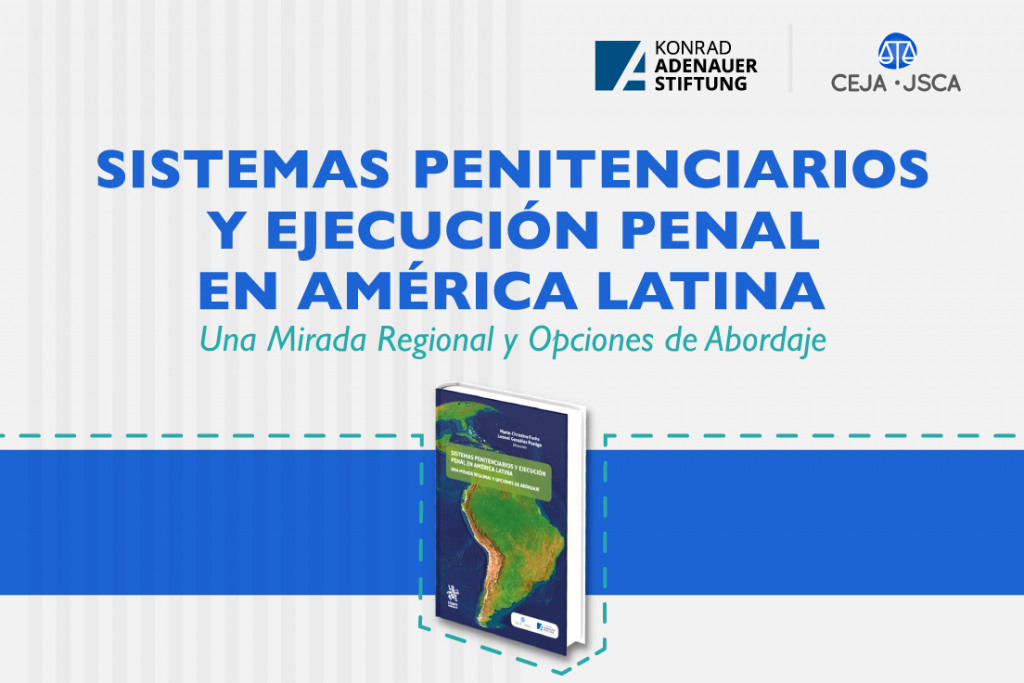
The research focuses on the current state of prisons in 10 countries in the region.
The Justice Studies Center of the Americas (JSCA), the Konrad Adenauer Foundation Rule of Law Program for Latin America and Editorial Tirant Lo Blanch present the Spanish-language publication “Prison Systems and Sentence Execution in Latin America: A Regional Perspective and Approaches.”
The publication, which was edited by JSCA Training Director Leonel González and Marie-Christine Fuchs, the KAS Regional Program Director,focuses on the current state of the prison system in 10 countries in the region (Argentina, Brazil, Chile, Colombia, Bolivia, Guatemala, Peru, Mexico, the Dominican Republic and Venezuela) and new courses of action.
JSCA Training Director Leonel González observed that the research seeks “to propose a regional work agenda related to prison systems and sentence execution.” For her part, KAS Regional Program Director Marie-Christine Fuchs notes that “the publication addresses a vital issue for the region and one that must be discussed at the comparative level.”
Structure: Six Chapters
The research, which is empirical in nature, has been organized into six chapters. Chapters 1 and 2 describe the international context related to the protection of the rights of inmates and inter-American standards for detention conditions, respectively.
Chapter 3 addresses gender policies in the area of sentence execution and the work that has yet to be done in the region.
Chapter 4, which emerged during the pandemic, analyzes the prison systems’ reactions to the public health crisis.
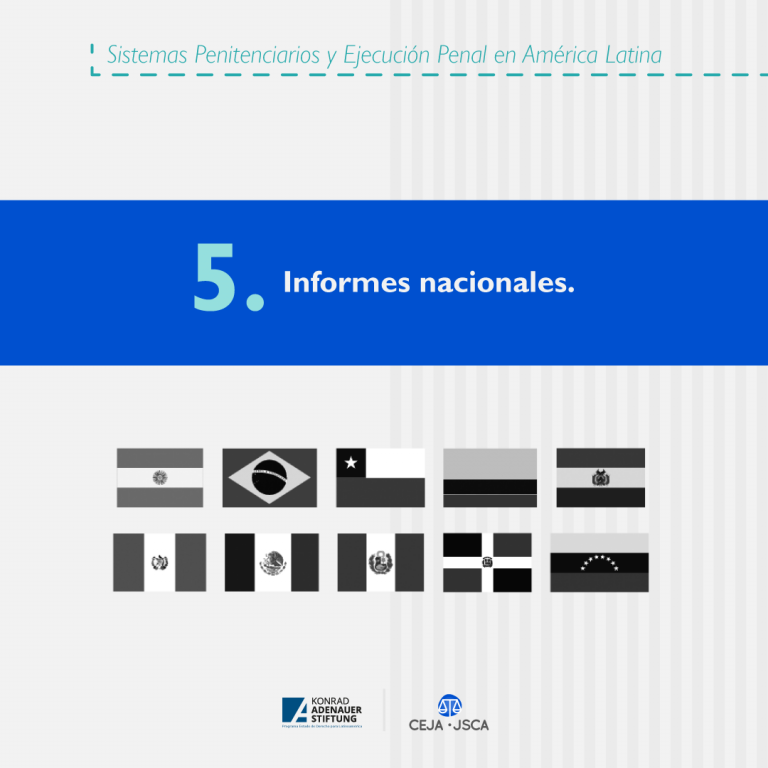
Chapter 5, the central axis of the research, presents country reports on Argentina, Brazil, Chile, Colombia, Bolivia, Guatemala, Peru, Mexico, the Dominican Republic and Venezuela. Various regional experts took part in the process of drafting the country reports.
Finally, Chapter 6 offers proposals for urgent general reforms and specific measures for improving prison systems and sentence execution.
Click here to download the publication. (In spanish)