New publication addresses key topics and lines of action for making criminal prosecution more efficient in the Americas

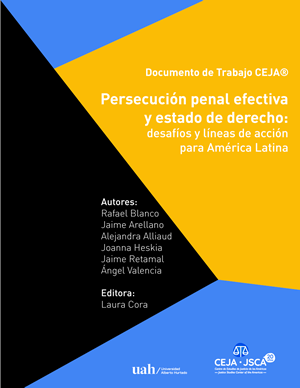
What is the reality of security and justice in Latin America and the Caribbean? How much does crime cost people? Can prosecutor’s offices and the police be more efficient? These are just some of the topics addressed in the new publication by the Justice Studies Center of the Americas (JSCA) and Universidad Alberto Hurtado entitled “Effective criminal prosecution and the rule of law: Challenges and lines of action for Latin America”
The authors describe why levels of peace and security in the region have deteriorated over the past ten years and how these indicators have been impacted by the emergence of crossborder organized crime, cybercrime, networks, and interwoven criminal groups; the appearance of new crimes in the financial sphere; and the repercussions of migration and displacement caused by political prosecution, state violence, threats, persecution by criminal organizations and narco-criminals.

The publication also shows that social pressure and judicial reforms in the countries that had the resources to build new prisons and expand or modify existing ones to house inmates who have been sentenced, detained or held in pretrial custody have contributed to the sustained increase in the prison population (the overall number of detainees) and the number of detainees held without convictions in the region.

The authors propose specific lines of action in such important areas in the security and justice system as public prosecutor’s offices, police agencies and the promotion of dispute resolution mechanisms that encourage the use of early and alternative outcomes. These responses shed light on the victims’ situation, cut short criminal careers and help to strengthen early reinsertion of convicted offenders.


Download the Executive Summary here (In spanish)


Download the full publication here (In spanish)

Noticias relacionadas:

The Justice Studies Center of the Americas (CEJA), with the support of the German Federal Foreign Office, officially launched in Trinidad and Tobago the course “Improving Criminal Prosecution and Resocialisation in Cases of Gender-Based Violence in Latin America and the Caribbean.” 
The President of the Supreme Court of Chile, Justice Gloria Ana Chevesich Ruiz, held a formal meeting with the Executive Director of the Center for Justice Studies of the Americas (CEJA), during which both authorities addressed matters of shared interest related to the strengthening of justice systems and regional cooperation.
CEJA welcomes Ana Aguilar as its new Executive Director for the 2026–2029 term and wishes her every success in this new stage of institutional leadership and management.
The Justice Studies Center of the Americas (CEJA) will carry out a study aimed at identifying and analyzing the main critical bottlenecks that arise in the application of Law No. 21.675, which establishes standards to prevent, punish, and eradicate violence against women based on gender, with a particular focus on its implementation within the Chilean Courts of Justice.
On Friday, November 28, CEJA’s Executive Director, Nataly Ponce, and the Coordinator of Studies and Training, Rodrigo Nakada, held a working meeting with Diego Oliveira Silva, Director General of the National School of the Public Defender’s Office of the Union (DPU) of Brazil.
The Justice Studies Center of the Americas (CEJA) participated in the International Workshop “Interculturality Approach in Policies for Afro-Descendant Populations”, organized by the Technical Secretariat of the Inter-American Network of High Authorities for Afro-Descendant Populations (RIAFRO) of the Organization of American States (OAS).