

On March 2, 2020, Santiago Pereira Campos (Uruguay) and Florencia Ratti Mendaña (Argentina) began their two-week research internship at Osgoode Law School in Toronto, Canada.
The two were selected through the 2019 competition that JSCA and York University organized with the financial assistance of Global Affaires Canada.
The interns were greeted by Associate Dean and Professor Sara Slinn and Associate Professor Shin Imai when they arrived at the host institution.
Santiago and Florencia had the opportunity to discuss their research topics and exchange opinions with their hosts about key topics related to civil justice reform in Canada and Latin America. They also shared important ideas on the training of judges and attorneys in Canada and Latin America.
The interns also used the opportunity to discuss the main ideas of their projects, which are aligned with the professors’ own interests.
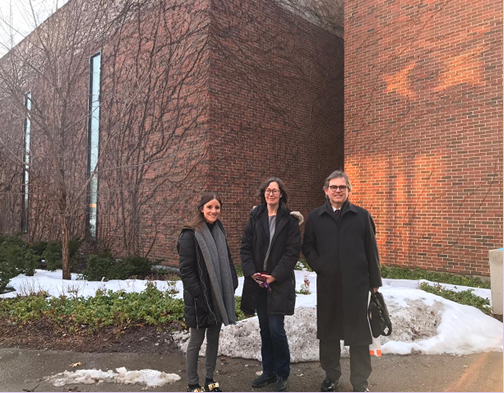
Santiago’s project is entitled “The Proportionality Principle, Case Management and the Role of Litigators, Judges and Attorneys.” For her part, Florencia will conduct an in-depth study of Canada’s precedent system. Both have received support from Professors Slinn and Imai that will undoubtedly enrich their work. In addition to meeting with their hosts, they toured the university library and other parts of the institution.
Florencia and Santiago have also received assistance from Professor Janet Walker, with whom they met individually. Professor Walker is one of the foremost experts on arbitration and litigation in the world.
In regard to her meeting, Florencia told JSCA that, “Professor Janet Walker mentioned the radical importance of collegiality in Canadian courts as a guarantee of stability in its proceedings. It is normal for judges to make an effort to reach an agreement in order to resolve a case and for them to draw on the work that other judges have done in the past. However, she noted that the practice of following precedent is more flexible in Canada than it is in the United States.”
Santiago remarked that, “Only 2% of civil cases go to trial in Canada. The rest are resolved using ADR methods.” He continued, “Universities train attorneys in a practical way so that they are trained to get involved in cases from the outset and seek to reach a solution among the parties. The system supports this cultural shift through the provision of financial incentives.”