The first case of a person infected with the COVID-19 virus in Latin America was reported at the end of February 2020. A few days later, during the month of March, justice systems began to develop mechanisms that would allow them to protect the health of their employees, operators, the parties to cases and anyone else who came to the courts even as they worked to ensure that they would continue to provide justice services.
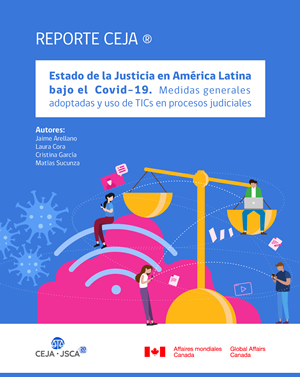
The CEJA-JSCA® Report “The state of justice in Latin America under COVID-19: General measures and the use of ICTs in judicial proceedings” (May 2020) offers an initial assessment of the responses provided by our region’s justice systems. It also contrasts them with the reality observed by operators, academics and experts trained by JSCA, offers conclusions, and presents considerations on the state of justice in the region in the context of the challenge that it is facing.
The authors gathered reports published on institutional websites that outline the measures taken by officials; talked with experts from different countries who offered their perspective on the operation of their justice systems during the pandemic; and conducted a survey to gather information about the experiences of JSCA Alumni Network members from 14 of the 16 countries that the entity covers.
The CEJA-JSCA® Report found that nearly all of the region’s judiciaries suspended services and judicial deadlines in response to the pandemic, maintaining a minimum level of service for urgent cases and matters. The report also indicates that most countries do not have protocols for holding virtual hearings that set out rules, standards and parameters for making them compatible with the exercise of guarantees and adversarial proceedings. Furthermore, JSCA found that there is a clear delay in the substantiation of proceedings: virtual hearings do not tend to include trials, and are limited to pre-trial or preliminary hearings in criminal and other types of cases.
The CEJA-JSCA® Report is an urgent approach to an ongoing phenomenon that opens up a series of possibilities, providing information on access to justice system services during the first stage of the pandemic. It also establishes a baseline for exploring justice system management topics –especially in regard to new methodologies and the use of information and communication technologies- and the challenges associated with making guarantees and rights effective in an imminent and technological (though uncertain) future.
Based on this, the CEJA-JSCA® Report states that there is an immediate need to design and implement a true “Contingency Plan for the Justice System in the Context of COVID-19” in each country in the region. And for the near future, it notes that there will be a need for a “Plan to Update Justice Systems” that anticipates the situation that we will face once the COVID-19 health crisis is over.
The CEJA-JSCA® Report concludes that it is possible to address the crisis, move beyond it and take the opportunity to create truly comprehensive and complex justice systems that address the needs, guarantees, effectiveness and efficiency of the prevention and resolution of disputes in our communities.
Click here to download the pdf.
Click here to visit the CEJA-JSCA® Report website.