New CEJA Publication: How To Assess Judicial Independence In The Americas

The Justice Studies Center of the Americas (CEJA) presents its latest publication: Indicators For Evaluating the Independence of Judges and Prosecutors in The Americas.
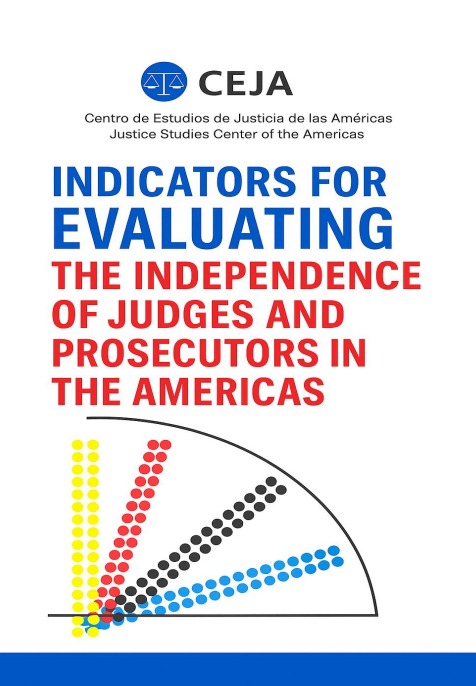
The Justice Studies Center of the Americas (CEJA) presents its latest publication: Indicators For Evaluating the Independence of Judges and Prosecutors in The Americas.

In a regional context marked by democratic backsliding, political polarization, and rising violence, the threats and risks faced by those who administer justice have intensified. This new book by CEJA offers a set of indicators for monitoring, preventing, and strengthening judicial independence in the region.

📌 What does this publication offer?
✔️ 57 technical, empirically verifiable indicators
✔️ Based on key international standards (IACHR, UN, Bangalore)
✔️ A practical, adaptable, and action-oriented approach
✔️ Methodological guide for analyzing harms, threats, risks, good practices, and protection measures
✔️ Applicable to both Judicial Branches and Public Prosecutor’s Offices

It also includes a classification by categories, analytical dimensions, and risk levels—a useful tool for judges, prosecutors, justice institutions, civil society, international organizations, and the academic sector.

Strengthening judicial independence means defending the rule of law in the Americas.

📘 Download the full report here.
📥 Download and share the publication in Spanish here.

Noticias relacionadas:

The Justice Studies Center of the Americas (JSCA/CEJA) successfully concluded the second edition of its regional program, “Artificial Intelligence and Justice Systems: Ethical Perspectives, Regulations, and International Experiences,” an initiative that brought together more than 40 participants from across the region interested in understanding the impact of artificial intelligence (AI) on the administration of justice.
Across the Americas, transforming justice remains one of the greatest challenges of our time. It is not only about modernizing institutions, but also about building systems that are more efficient, inclusive, and people-centered. 
On April 21, the final session of the course “Investigating Corruption by Following the Money” was held at the Office of the Director of Public Prosecutions in Trinidad and Tobago, marking the conclusion of this specialized training in the country. 
Regional cooperation on justice and citizen participation continues to advance through a new meeting led by the Organization of American States, which brought together in Chile the Center for the Study of Justice of the Americas with civil society organizations, academia, and justice system stakeholders.
On April 17, the Justice Studies Center of the Americas (JSCA) held the closing session of the course “Improving Criminal Prosecution in Cases of Gender-Based Violence in Trinidad and Tobago”, marking the completion of this specialized training programme.