
Judicial Systems, a journal edited by the Justice Studies Center of the Americas (CEJA) and the Institute for Comparative Studies in Criminal and Social Sciences (INECIP), launches its 25th issue, focusing on the achievements and challenges of judicial offices, two decades after their implementation in various Latin American judicial institutions.
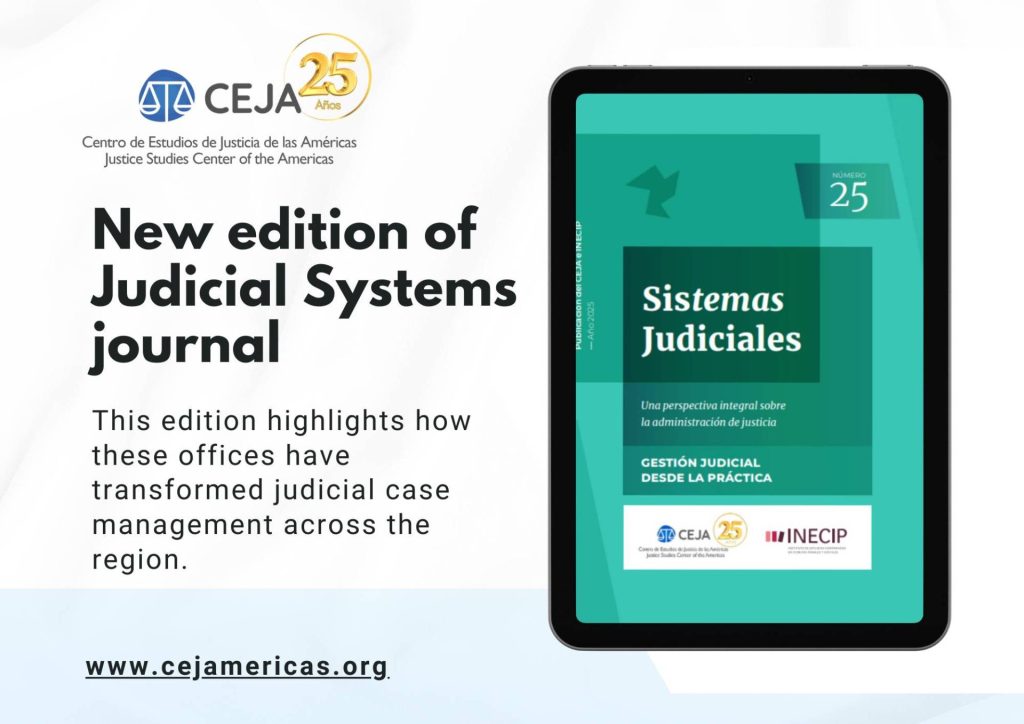
This edition highlights how these offices have transformed judicial case management across the region.
The publication features case studies, analyses, and expert reflections examining the current state and evolution of judicial offices in Latin America. Key topics include the separation of judicial and administrative functions within judicial branches, as well as the obstacles, resistance, and progress experienced in various countries.
Issue No. 25 also explores the impact of technology on justice and analyzes different judicial management models implemented in Mexico, Guatemala, Uruguay, Argentina, Bolivia, Costa Rica, and Chile.
What topics will you find?
This issue covers Mexico (Coahuila), showcasing improvements in court management and process timelines. In Bolivia, it looks at the implementation of process management offices and the challenges they face.
It illustrates how Chile is encountering significant resistance to change, while Guatemala, Uruguay, and Argentina highlight innovative judicial management models. Lastly, Costa Rica is examined for how judicial office reorganization has impacted efficiency and service quality. These cases offer a comparative perspective to identify best practices and areas for improvement in the region.
Expert Voices
This edition features renowned justice administration specialists, including:
-
Bruno Novoa Campos, President of CEJA’s Board of Directors
-
Aldana Romano, Co-director of the INECIP Judicial Management Program
-
José Manuel Gutiérrez Velásquez, Constitutional Judge, Departmental Court of Justice of Santa Cruz, Bolivia
-
Silvia Consuelo Ruiz Cajas, Judge, Criminal First Instance Court, Quetzaltenango, Guatemala C.A.
-
Santiago Alberto Miguelez, Deputy Director General of Judicial Offices of the Judiciary of Río Negro, Argentina, and President of the National Institute of Judicial Offices
-
Sidonie Porterie, judicial reform specialist and INECIP member.