
CEJA Launches Its New Website to Improve and Modernize Access to Justice Information and Knowledge in the Region

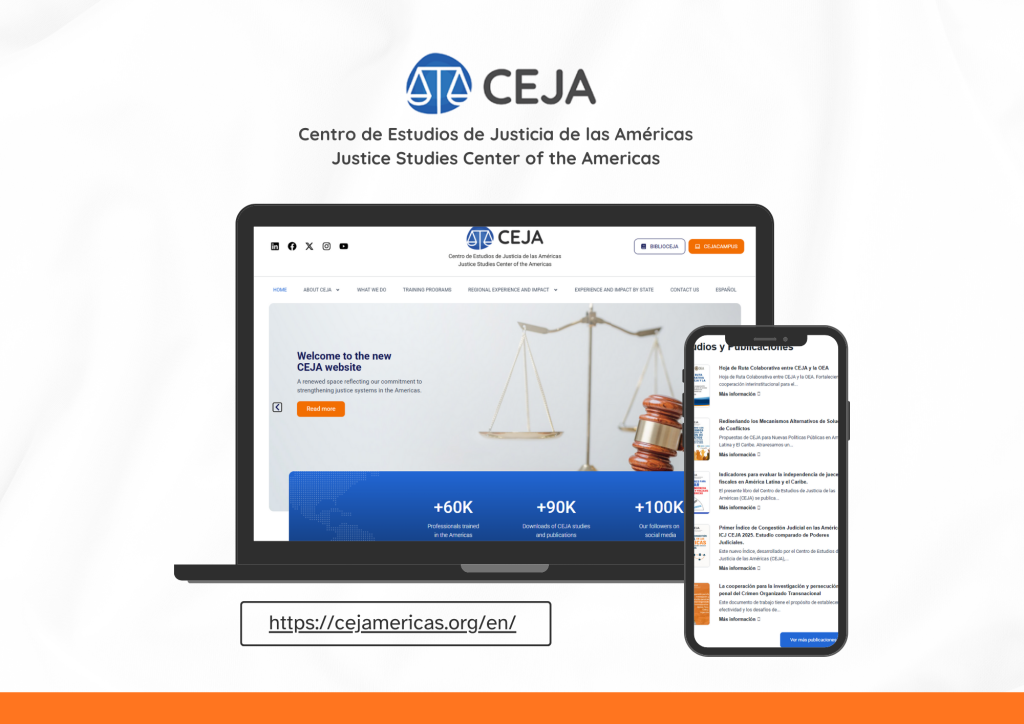
CEJA presents its new website, a fully renewed platform that modernizes the browsing experience and facilitates access to information, studies, and resources on justice in Latin America and the Caribbean.

With an updated, more accessible, and user-centered design, this digital space represents a significant step in strengthening the Center’s regional role.

A More Intuitive, Accessible, and Region-Oriented Platform

CEJA’s new website features a clearer and more functional navigation architecture, allowing users to explore institutional content more efficiently. Among its main innovations is the incorporation of thematic areas that reflect current justice-related challenges, as well as the comprehensive organization of both historical and up-to-date institutional materials at the regional level and by individual country. This facilitates access to studies, training programs, technical assistance, and other activities carried out by CEJA across OAS Member States.

The renewed visual design enhances the user experience and strengthens CEJA’s digital identity, increasing engagement with its regional audience and creating a dynamic, up-to-date space aligned with international communication standards.

Words from the Executive Director

“We have renewed CEJA’s website to offer a more accessible, modern, and dynamic digital space that reflects our institutional commitment to strengthening justice systems in Latin America and the Caribbean. We hope our community will find knowledge, evidence, and inspiration there to continue transforming justice systems in the Americas together,” said CEJA Executive Director Nataly Ponce Chauca in her welcome message.

An Institutional Milestone

This update marks the first comprehensive renovation of CEJA’s website since its creation more than 20 years ago, constituting an important institutional milestone and responding to current needs for transparency, access to comparative data, and the availability of knowledge tools for the regional legal community.

An Updated Space for a Regional Community

This renewal also extends to CEJA’s associated platforms: the BiblioCEJA digital library and CEJACampus, its virtual learning space, which now feature a more coherent presentation aligned with the institution’s new digital identity.

Noticias relacionadas:

CEJA welcomes Ana Aguilar as its new Executive Director for the 2026–2029 term and wishes her every success in this new stage of institutional leadership and management.
The Justice Studies Center of the Americas (CEJA) will carry out a study aimed at identifying and analyzing the main critical bottlenecks that arise in the application of Law No. 21.675, which establishes standards to prevent, punish, and eradicate violence against women based on gender, with a particular focus on its implementation within the Chilean Courts of Justice.
On Friday, November 28, CEJA’s Executive Director, Nataly Ponce, and the Coordinator of Studies and Training, Rodrigo Nakada, held a working meeting with Diego Oliveira Silva, Director General of the National School of the Public Defender’s Office of the Union (DPU) of Brazil.
The Justice Studies Center of the Americas (CEJA) participated in the International Workshop “Interculturality Approach in Policies for Afro-Descendant Populations”, organized by the Technical Secretariat of the Inter-American Network of High Authorities for Afro-Descendant Populations (RIAFRO) of the Organization of American States (OAS).
On November 19, the International Seminar on the Dissemination of the Case Management Protocol was held in Panama City, marking a key milestone in the process of modernizing Panama’s civil justice system. The initiative was jointly promoted by Panama’s Judicial Branch and the Justice Studies Center of the Americas (CEJA).
The Justice Studies Center of the Americas (CEJA) will launch on October 28 in Ecuador the Specialized Program “Governance and Modern Management of High Jurisdictional Courts”, developed in partnership with the National Court of Justice of Ecuador and the International Italo-Latin American Organization (IILA), within the framework of the FIEDS/ITAJUS project.