“Ways to resolve civil and family conflicts and their effectiveness in Colombia and Peru” (IDRC – JSCA)

Throughout 2023, two JSCA consulting teams formed by Mateo Vasquez Echeverri, Samed Mateo Vargas Montero, Leonardo García and Lizeth Johanna Ñungo Pérez (Colombia) and the Former Minister of Justice and Human Rights Eduardo Vega Luna, Federico Chunga Fiestas and Cristell Paola Casani Apaza (Peru) have traveled to six locations in these countries to meet with officials from conciliation centers, with the aim of reflecting and analyzing the different judicial and non-judicial solutions that exist for the resolution of family and marriage conflicts. living place.
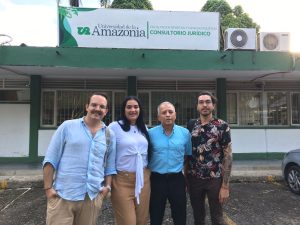
This territorial deployment is carried out within the framework of the project “Ways to resolve civil and family conflicts and their effectiveness in Colombia and Peru”, promoted by the International Development Research Center (IDRC).
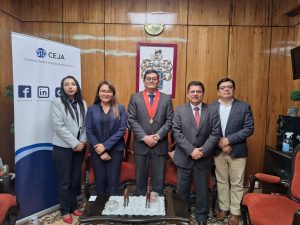
The teams have been in Barranquilla, Bogotá and Florencia, Iquitos, Lima and Arequipa, visiting conciliation centers, Superior Courts of Justice and judicial institutions, where professionals and users have been interviewed.

Noticias relacionadas:

The Justice Studies Center of the Americas (CEJA), with the support of the German Federal Foreign Office, officially launched in Trinidad and Tobago the course “Improving Criminal Prosecution and Resocialisation in Cases of Gender-Based Violence in Latin America and the Caribbean.” 
The President of the Supreme Court of Chile, Justice Gloria Ana Chevesich Ruiz, held a formal meeting with the Executive Director of the Center for Justice Studies of the Americas (CEJA), during which both authorities addressed matters of shared interest related to the strengthening of justice systems and regional cooperation.
CEJA welcomes Ana Aguilar as its new Executive Director for the 2026–2029 term and wishes her every success in this new stage of institutional leadership and management.
The Justice Studies Center of the Americas (CEJA) will carry out a study aimed at identifying and analyzing the main critical bottlenecks that arise in the application of Law No. 21.675, which establishes standards to prevent, punish, and eradicate violence against women based on gender, with a particular focus on its implementation within the Chilean Courts of Justice.
On Friday, November 28, CEJA’s Executive Director, Nataly Ponce, and the Coordinator of Studies and Training, Rodrigo Nakada, held a working meeting with Diego Oliveira Silva, Director General of the National School of the Public Defender’s Office of the Union (DPU) of Brazil.
The Justice Studies Center of the Americas (CEJA) participated in the International Workshop “Interculturality Approach in Policies for Afro-Descendant Populations”, organized by the Technical Secretariat of the Inter-American Network of High Authorities for Afro-Descendant Populations (RIAFRO) of the Organization of American States (OAS).