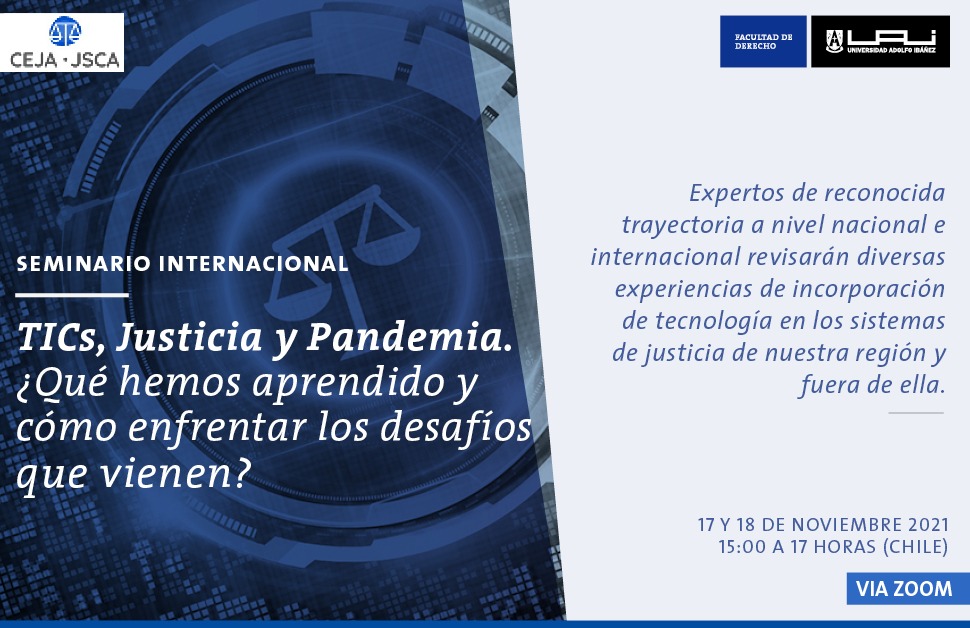
The Justice Studies Center of the Americas (JSCA) and the Universidad Adolfo Ibáñez (UAI) Law School invite you to the international seminar ICTs, Justice and the Pandemic: What Have We Learned and How Can We Address Future Challenges? The event will take place November 17 and 18, 2021.
Seminar participants will analyze experiences with the incorporation of technology into the justice systems of the region and other countries in response to the COVID-19 pandemic.
The seminar will be held virtually from 3 p.m. to 5 p.m. local time.
November 17
Panel I: Best Practices at the International Level: Ideas for Addressing Post-Pandemic Challenges This panel will be moderated by JSCA researcher Gonzalo Fibla, who will be joined by panelists: Ricardo Lillo, an academic at the UAI Law School; Dory Reiling, Independent IT and judicial reform expert, retired Senior Judge with the Amsterdam District Court and Senior Judicial Reform Specialist at the World Bank; Jason Tashea, Editor of the Justice Tech Download newsletter, Distinguished Visiting Technologist at George Washington University Law School and consultant at the World Bank; and Shannon Salter, Chair of the Civil Resolution Tribunal (British Columbia) and Adjunct Professor at the University of British Columbia Allard School of Law.
November 18
JSCA researcher Pablo Cantillana will moderate Panel II: The Experience of Justice in Latin America with the Incorporation of ICTs during the Pandemic This panel will feature JSCA Executive Director Jaime Arellano; Alyx Mark, Assistant Professor of Government at Wesleyan University; and María Eugenia Sandoval, Coordinator of the Case Law Modernization Project at the Chilean Supreme Court.
The panel will also include Enrique Vergara, President of the Free Competition Defense Court; María José Poblete, an attorney and clerk in the Free Competition Defense Court; Luis Guillermo Rivas, a justice who sits in the First Chamber of the Supreme Court of Costa Rica; Juan Gustavo Corvalán, Director of the Artificial Intelligence Laboratory at the Universidad de Buenos Aires Law School; and Laurence Pantín, Coordinator of México Evalúa’s Transparency in Justice Program.
Please use this link to register for the event.