New issue of Judicial Systems Journal: Criminal analysis in Latin America

The Justice Studies Center of the Americas (JSCA) and the Institute for Comparative Studies in the Criminal and Social Sciences (INECIP) present a new issue of Judicial Systems Journal. The main topic of the issue is criminal analysis in the region’s public prosecutor’s offices based on perspectives and experiences from over 10 countries.
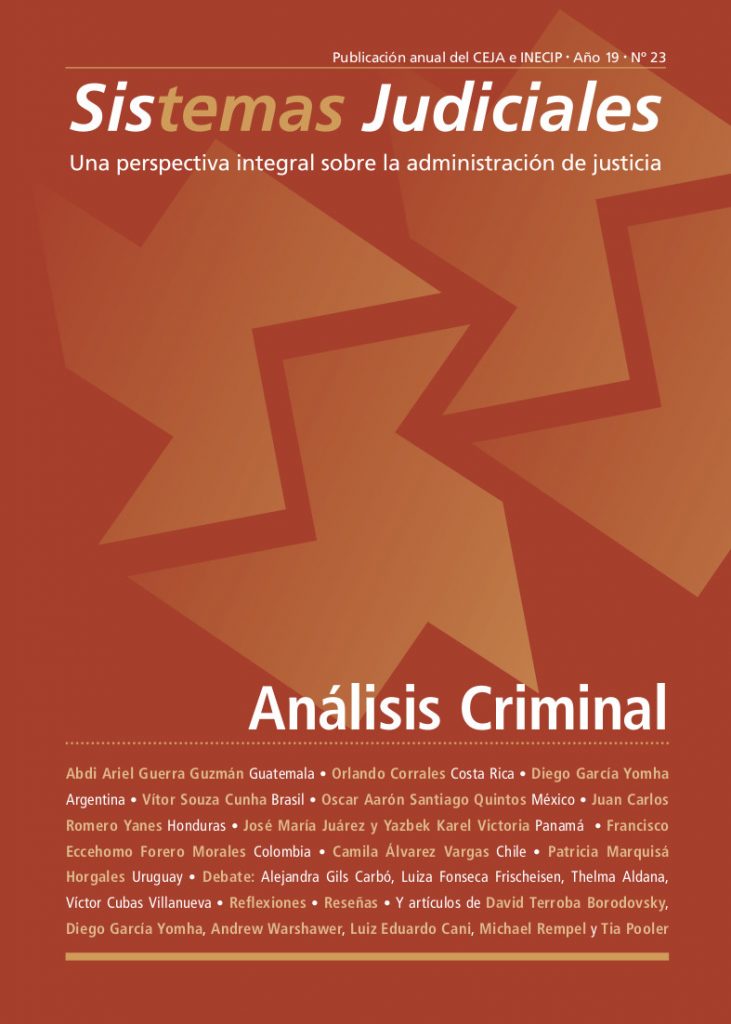
Issue 23 of the journal starts with a discussion of the need to understand criminal phenomena and organizations, which have become more professional and have improved their skills, in order to provide adequate responses to genuine social demands and to contribute to democratizing the justice system.

In this context, it explores the roles of Latin America’s public prosecutor’s offices in the creation of criminal analysis offices and the design of strategic prosecution plans. The new issue focuses on the most important regional advances related to the criminal analysis of specific criminal phenomena that serve as an experience for marking the path towards strategic and democratic prosecution.  

The journal is directed by Leonel González (JSCA) and Gonzalo Rua (INECIP). The contributors to this issue are: Abdi Ariel Guerra Guzmán, Orlando Corrales, Diego García Yomha, Victor Souza Cunha, Oscar Aarón Santiago Quintos, Juan Carlos Romero Yanes, José María Suárez y Yazbek Kari Victoria, Francisco Eccehomo Forero Morales, Camila Álvarez Vargas, Patricia Marquisá Horgales, David Terroba Borodovsky, Andrews Warshawer, Luiz Eduardo Cani, Michael Rempel and Tia Pooler. The discussion section presents opinions and analyses by Alejandra Gils Carbó (Argentina), Luiza Fonseca Friescheisen (Brazil), Thelma Aldana (Guatemala) and Victor Cubas Villanueva (Peru). Finally, the journal also includes book reviews and short pieces on other topics related to justice administration.

Noticias relacionadas:

The Justice Studies Center of the Americas (CEJA) will carry out a study aimed at identifying and analyzing the main critical bottlenecks that arise in the application of Law No. 21.675, which establishes standards to prevent, punish, and eradicate violence against women based on gender, with a particular focus on its implementation within the Chilean Courts of Justice.
On Friday, November 28, CEJA’s Executive Director, Nataly Ponce, and the Coordinator of Studies and Training, Rodrigo Nakada, held a working meeting with Diego Oliveira Silva, Director General of the National School of the Public Defender’s Office of the Union (DPU) of Brazil.
The Justice Studies Center of the Americas (CEJA) participated in the International Workshop “Interculturality Approach in Policies for Afro-Descendant Populations”, organized by the Technical Secretariat of the Inter-American Network of High Authorities for Afro-Descendant Populations (RIAFRO) of the Organization of American States (OAS).
On November 19, the International Seminar on the Dissemination of the Case Management Protocol was held in Panama City, marking a key milestone in the process of modernizing Panama’s civil justice system. The initiative was jointly promoted by Panama’s Judicial Branch and the Justice Studies Center of the Americas (CEJA).
The Justice Studies Center of the Americas (CEJA) will launch on October 28 in Ecuador the Specialized Program “Governance and Modern Management of High Jurisdictional Courts”, developed in partnership with the National Court of Justice of Ecuador and the International Italo-Latin American Organization (IILA), within the framework of the FIEDS/ITAJUS project.
The Justice Studies Center of the Americas (CEJA) presented to the Committee on Juridical and Political Affairs (CAJP)