Presentation of JSCA’s Annual Report at the 54th regular session of the General Assembly of the Organization of American States (OAS)

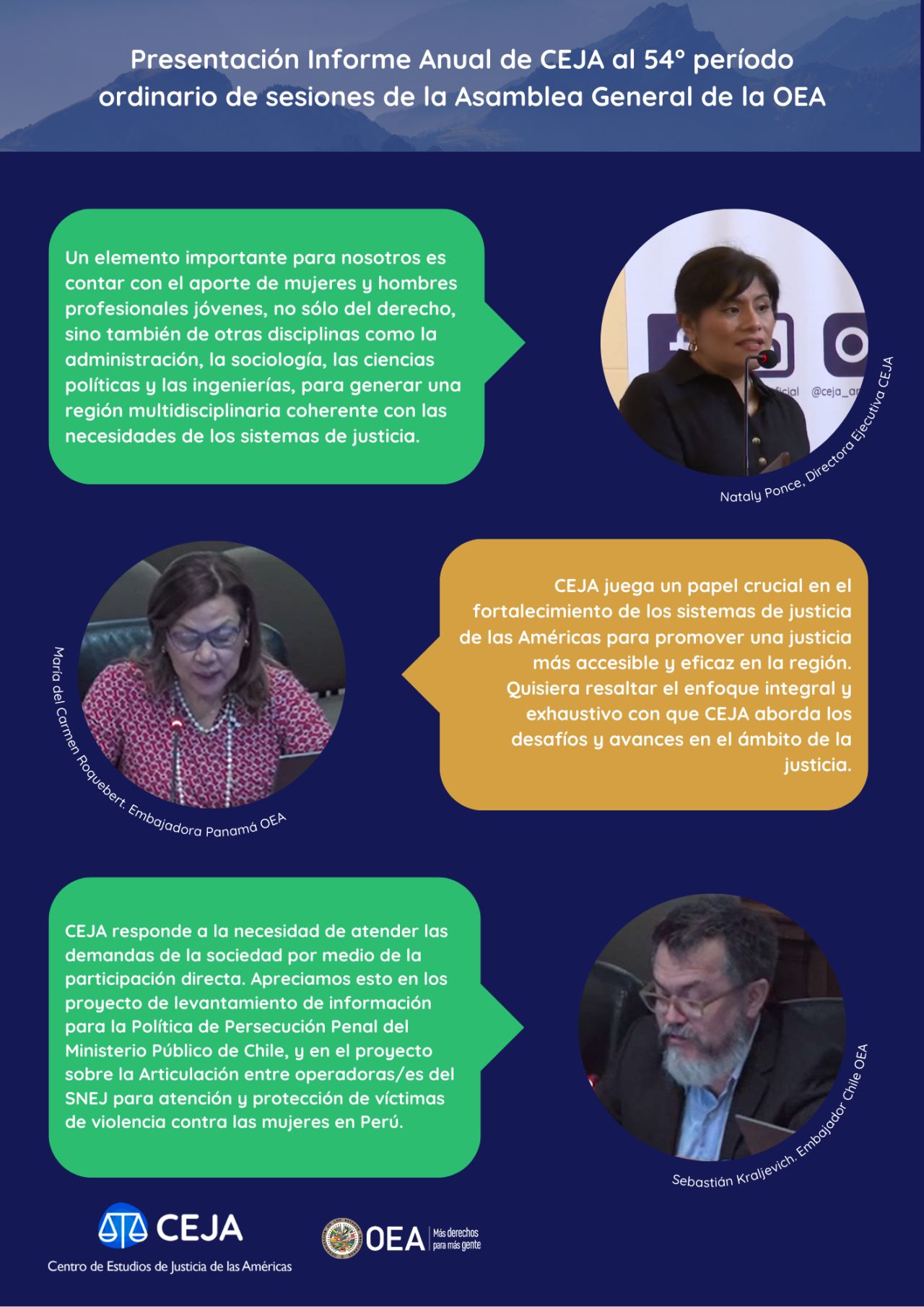
On Thursday, April 11, JSCA Executive Director Nataly Ponce Chauca presented the institution's 2023 Annual Report to the General Assembly of the Organization of American States (OAS).

At the event, Nataly Ponce provided information on the most relevant projects developed by JSCA last year, including “Citizen and Participatory Survey for the Design of the Criminal Prosecution Policy of the Public Prosecutor’s Office of Chile,” in which JSCA was deployed in all regions of the country conducting 22 participatory citizen workshops to gather information on criminality, in addition to conducting a Citizen Consultation with the participation of more than 2,000 people. Following this line, JSCA developed the project “Articulation among operators of the National Specialized Justice System (SNEJ) for the care and protection of victims of violence against women and family members” in Peru, where eight municipalities were visited and workshops and interviews were conducted with officials of the institutions that make up the SNEJ.

In 2023, JSCA also began the project “Family and Civil Conflict Resolution and its Effectiveness in Colombia and Peru,” in conjunction with the International Development Research Centre (IDRC), where teams of consultants from both countries were deployed in more than 15 territories to interview authorities, officials and users of mediation and conciliation centers in order to identify problems and develop a public policy proposal to strengthen mediation in the region.

We share here excerpts from the interventions carried out on JSCA’s work during 2023.
Noticias relacionadas:

The Justice Studies Center of the Americas (JSCA/CEJA) successfully concluded the second edition of its regional program, “Artificial Intelligence and Justice Systems: Ethical Perspectives, Regulations, and International Experiences,” an initiative that brought together more than 40 participants from across the region interested in understanding the impact of artificial intelligence (AI) on the administration of justice.
Across the Americas, transforming justice remains one of the greatest challenges of our time. It is not only about modernizing institutions, but also about building systems that are more efficient, inclusive, and people-centered. 
On April 21, the final session of the course “Investigating Corruption by Following the Money” was held at the Office of the Director of Public Prosecutions in Trinidad and Tobago, marking the conclusion of this specialized training in the country. 
Regional cooperation on justice and citizen participation continues to advance through a new meeting led by the Organization of American States, which brought together in Chile the Center for the Study of Justice of the Americas with civil society organizations, academia, and justice system stakeholders.
On April 17, the Justice Studies Center of the Americas (JSCA) held the closing session of the course “Improving Criminal Prosecution in Cases of Gender-Based Violence in Trinidad and Tobago”, marking the completion of this specialized training programme.