
The Special Rapporteur on the Independence of Judges and Lawyers, Margaret Satterthwaite, visited Chile at the invitation of the government between July 29 and August 9, where she held dialogues with State officials and representatives of international organizations and civil society on good practices and challenges regarding the independence of judges and lawyers and how this underpins respect for human rights.
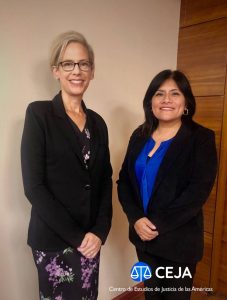
In this context, CEJA Executive Director Nataly Ponce participated in a meeting with the Special Rapporteur on Tuesday, July 30 at the headquarters of the Regional Office for South America of the United Nations High Commissioner for Human Rights, where they discussed Chile’s progress and challenges in the area of judicial independence. Among other issues, the need for the separation of administrative and jurisdictional functions in the Supreme Court was addressed, as well as the country’s progress and challenges in guaranteeing effective access to justice for individuals and groups in vulnerable situations.
At the meeting, Nataly Ponce indicated that in Chile the threats and risks to judicial independence do not have the same characteristics and severity as in other countries in the region; however, there are several challenges related to the role of the Supreme Court and the Court of Appeals in the appointment and career path of judges. The Executive Director also emphasized the importance of ensuring the autonomy of prosecutors, whose role is crucial in the fight against organized crime and corruption. In this context, she referred to the findings of the CEJA regional study on the independence of judges and prosecutors published in 2023, and to the seminar on the protection of prosecutors and judges that our organization organized in June 2024 within the framework of the 54th OAS General Assembly.
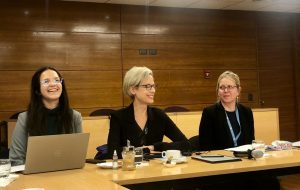
Our executive director shared that our institution is about to publish the JSCA instrument for measuring the independence of judges and prosecutors, which seeks to contribute to the self-evaluation of justice operators and the use of civil society to establish the situation in each country and institution, and to take the necessary preventive and corrective measures.
To access the CEJA study on judicial independence in Latin America click on the following link ⬇⬇⬇⬇⬇
https://biblioteca.cejamericas.org/handle/2015/5712
To access the CEJA seminar on the protection of prosecutors and judges in Latin America click on the following link ⬇⬇⬇⬇⬇