With great participation and important discussions, the four parallel events organized by JSCA were held within the framework of the 54th General Assembly of the OAS, in conjunction with the Ministry of Foreign Affairs of Germany, the Government of Paraguay, GIZ, International Development Research Center (IDRC), the Inter-American Commission of Women (CIM) of the OAS, the Ibero-American Association of Public Ministries, International Center for Not-for-Profit Law (ICNL), Due Process of Law Foundation – DPLF and the Study Center Judicial.
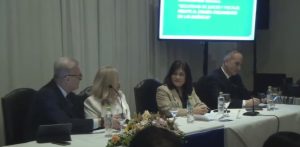
The series of parallel events began on Wednesday the 26th with the discussion “Women’s rights in rural areas and their access to justice”, where important authorities participated. Juana Herrera, Minister of Women of Panama, assured in her speech her commitment to continue “working to generate spaces for dialogue, good practices and strengthening of rights that elevate the voices of rural women, who only need spaces, because voices have». Along the same lines, the Vice Minister of Foreign Affairs of Paraguay said that “women’s rights have achieved significant progress worldwide, but we are aware of the barriers that still persist in rural areas, where there are gaps due to geographical and economic limitations.” For her part, Annette Walter, Director for Latin America and the Caribbean of the German Ministry of Foreign Affairs, reaffirmed her “commitment to improving the lives and rights of rural women. In Latin America, they represent almost 40% of the workforce, but their work does not receive adequate economic recognition.” Also participating in the event were Luz Haro Guanga, Former National Electoral Councilor of Ecuador, and Terry Ince, Founder and Coordinator of the CEDAW Committee of Trinidad and Tobago (CCoTT).

Subsequently, the event “Inter-American Principles, Civil Society and Freedom of Association” was held, where María Victoria Rivas, President of the Board of Directors of JSCA, mentioned at the inauguration the serious problem suffered by countries such as Nicaragua, Peru, Venezuela, “where governments both «On both the right and the left, they limit the right of association.» Ramiro Orias, from the Inter-American Juridical Committee (CJI), and Enrique Roig, Deputy Undersecretary of the US Department, among other authorities and experts, participated in the event. In his speech, Orias stated that “the right to create a civil society organization is part of freedom of association, and must have all the protections that a fundamental freedom has, and should not be arbitrarily restricted.”
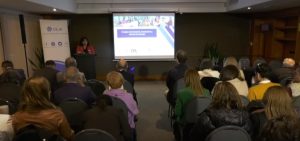
On Thursday the 28th, the event “Security of Judges and Prosecutors against Organized Crime in the Americas” was held in the morning. At the event, Nataly Ponce, Executive Director of JSCA, stressed the importance of “building a roadmap to prevent, in a technical and sustainable manner, the challenges we face due to the perpetration of criminal networks in our countries in justice institutions.” ”. In the afternoon, the event “Pathways to Conflict Resolution and Vulnerable Populations in the Americas” was held, with the participation of Mateo Vasquez, conciliation lawyer expert in conflict resolution methods, and Eduardo Vega, former Minister of Justice of Peru.