Over the past eight years, the Justice Studies Center of the Americas (JSCA) has promoted and supported justice system transformation processes as well as mechanisms for fostering access to justice for millions of people in the region. In response to the restrictions and consequences of the COVID-19 pandemic, we adapted, innovated and increased our activity.
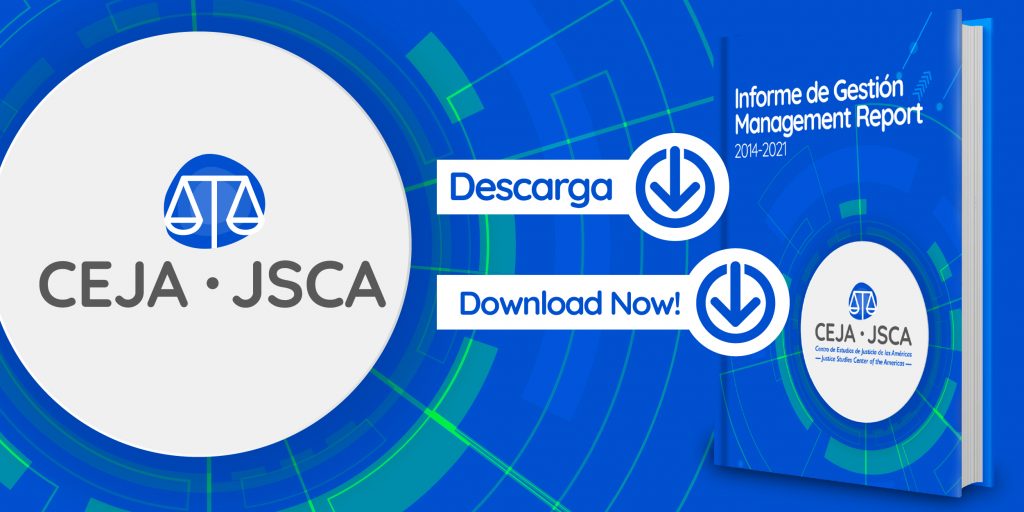
JSCA’s team has compiled information about the work performed during the term of our current Executive Director, Jaime Arellano. Today, we are launching the 2014-2021 Management Report, which organizes this information into six strategic priorities: Institution, Gender Equality, Research and Projects, Training, Communications and Outreach, and Administration and Finance.
“We began this term in 2014 by promoting justice system transformation policies throughout the continent that had been undertaken and led by my predecessors in the area of criminal justice. We also focused on making important changes in the area of civil justice,” explains JSCA Executive Director Jaime Arellano.
“We launched new initiatives such as the Certificate Program on Oral Criminal Litigation (DLOP) in collaboration with American University Washington College of Law (AU-WCL) and Universidad Alberto Hurtado (UAH). The Center also implemented the project ‘Improving Access to Civil Justice in Latin America’ with the technical and financial support of Global Affairs Canada (GAC),” he notes.
In addition, JSCA established a gender equality policy and created the region’s first Observatory on Civil Conflict and Access to Justice (OCCA). “We also implemented the Training Program on Research and Litigation in Argentina’s New Federal Adversarial Criminal Justice System with financing from INL and adjusted to a new reality due to the pandemic.”
“In this Management Report, we describe both the progress that we have made over the years and the challenges related to transforming the continent’s justice systems in order to contribute to democracy, social peace and wellbeing for all,” Arellano adds.
JSCA Executive Director Jaime Arellano began his term in January 2014 and will leave JSCA after eight years on December 31, 2021, the maximum term allowed under the Center’s Statutes. During this time, JSCA has become a point of reference in the region in the areas of justice, gender and training. It has positioned itself as a technical organization that integrates diverse nationalities, perspectives and opinions from throughout the Americas with a gender equality policy that has become its hallmark.
We invite you to know our Management Report 2014-2021 HERE
You can also visit the web version HERE